The Himalayas are sending a warning that can no longer be dismissed as another seasonal story of rain, landslides and washed-out roads.
In the space of barely a month, Nepal has been struck by a catastrophic ice-rock avalanche and flash flood, followed by another wave of floods and landslides and then a deadly avalanche at Himlung Himal. Across the wider Himalayan region, India has simultaneously faced repeated cloudbursts, extreme rainfall, flash floods and landslides.
The pattern is becoming increasingly difficult to ignore: natural hazards are colliding with a rapidly expanding human footprint in one of the world’s most fragile mountain systems.
The latest crisis in Nepal began on September 24, when torrential rain triggered floods and landslides across several districts. By September 27, Nepal’s disaster authorities had reported at least 12 deaths and seven people missing; subsequent reports put the toll still higher as the disaster unfolded. More than 1,100 people had been evacuated, while authorities warned of flash-flood risks across 49 of Nepal’s 77 districts.
Then came another blow when on September 27, an avalanche tore through the base camp of Himlung Himal, a 7,126-metre peak in Manang district. The avalanche struck while Nepali workers were preparing the camp for the autumn climbing season. At least four people were confirmed dead and 12 were reported missing as rescue teams battled severe weather and difficult terrain.
In nearby Manang, torrential rain also triggered a massive landslide that sent an entire section of mountain into the Marsyangdi River, temporarily blocking its flow and raising fears of further flooding downstream.
But Nepal was already carrying the wounds of a far greater catastrophe.
The mountain that collapsed into a flood
On August 26, an enormous mass of ice and rock detached near the Nepal-China border in the upper Bhote Koshi watershed.
The collapse transformed into a highly mobile debris flow and flash flood that travelled nearly 100 kilometres, devastating communities and infrastructure downstream, including the Rasuwagadhi border area and a vital highway connecting Nepal and China. The US Geological Survey described the event as a catastrophic debris flow and flood following rapid slope failure involving a glacier.
Nepal’s National Society for Earthquake Technology found that approximately one square kilometre of rock-glacier material detached and rapidly moved downslope, entraining enormous quantities of sediment and water.
The disaster left more than 1,400 people dead and nearly 6,000 missing, according to subsequent reporting, devastating communities already vulnerable to poverty, difficult terrain and limited access.
The tragedy exposed something bigger than the destructive power of one mountain collapse exposing how quickly a natural event in the high Himalayas can cascade through a densely connected network of rivers, roads, bridges, hydropower projects, settlements and border infrastructure.
When a natural hazard becomes a human disaster
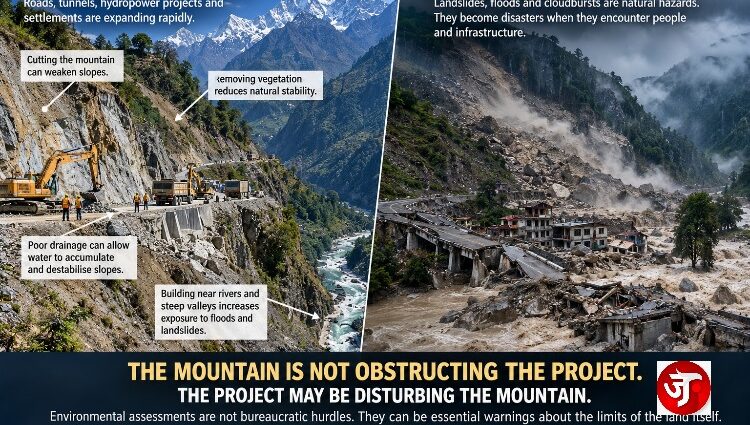
Landslides, floods, avalanches, and earthquakes are natural. They have been happening since the beginning of Earth. Disaster strikes when a natural calamity encounters people and infrastructure, which is becoming critical in the Himalayas.
Roads and highways are being carved into steep slopes. Tunnels are being drilled through mountains. Hydropower projects are being built along rivers and narrow valleys. Hotels, homes and entire settlements are expanding into terrain that is inherently vulnerable to landslides, floods and avalanches.
The World Bank has long warned that Himalayan roads and infrastructure face severe exposure to landslides and flash floods. In mountainous terrain, extreme rainfall can trigger slope failure, erode roads and destroy bridges, while inadequate drainage can dramatically increase vulnerability.
This does not mean that every road or hydropower project causes a disaster, rather a poorly planned development can turn a hazard into a catastrophe. Cut a mountain without adequately understanding its geology and you may weaken the slope; altering natural drainage and water can accumulate where it should not; removing vegetation destabilises the surface, construction besides river causes the consequences of an extreme flood to impact the people in horrific ways; put critical infrastructure in a narrow valley and a landslide upstream can cut off an entire region.
The mountains are not passive pieces of land waiting to be conquered by bulldozers, rather they are dynamic geological systems.
Climate change is adding another layer of danger
The problem is being compounded by a changing climate. India’s Ministry of Home Affairs, citing assessments by weather experts, scientific institutions and government agencies, has said that climate change is increasing the intensity and frequency of extreme rainfall events in the Himalayan region. It also identified accelerated snowmelt and moraine instability as contributors to slope failures and high runoff at high altitudes, while noting that anthropogenic factors have contributed to the increased risk.
That does not mean every flood or landslide can simply be labelled “climate change”. The Himalayas have always experienced extreme weather, earthquakes, landslides and avalanches. What is changing is the risk environment: warmer conditions, shifting precipitation patterns, extreme rainfall and increasingly exposed populations and infrastructure can interact in ways that make disasters more destructive.
And the past three months have provided a grim catalogue.
Across June, July, August and September, the Himalayan region has experienced repeated landslides, flash floods, cloudbursts, extreme rainfall, glacier-related hazards, avalanches and earthquakes.
In Himachal Pradesh, the government has acknowledged an increasing frequency and intensity of cloudbursts, flash floods, landslides and extreme rainfall. The World Bank has also described the state’s growing exposure to extreme weather and the damage it causes to roads, bridges and communities.
In Nepal, the August ice-rock avalanche and flash flood was followed within weeks by another deadly sequence of floods, landslides and the Himlung avalanche.
This is no longer simply a question of whether the Himalayas are experiencing disasters. It is a question of why so many people and so much infrastructure are being placed directly in their path.
The Himalayan paradox
There is, however, no simple answer. The Himalayas need development as roads connect isolated communities. Electricity brings opportunity, hydropower is vital to economies and bridges, hospitals, schools and communication networks are essential.
So, the answer cannot be to freeze the mountains in time. The real question is how development is carried out. Before cutting another road into a mountainside, authorities must ask whether the slope can withstand it, ahead of building another settlement beside a river, they must ask what happens during an unprecedented flood; and before constructing another hydropower project in a narrow valley, they must examine what happens when a landslide, avalanche or debris flow occurs upstream.
An environmental assessment should not be treated as an unnecessary bureaucratic obstacle that slows down construction. Sometimes the environmental conditions themselves are warning that a project may be unsafe or unsuitable for that particular location.
The mountain is warning us.
The disasters unfolding across Nepal and the wider Himalayas are therefore not evidence that nature has suddenly declared war on humanity, but evidence of something more uncomfortable.
Nature creates the hazard. Climate change can intensify the conditions. Human decisions determine how much is exposed to the blow.
The next Himalayan disaster may begin with a cloudburst, a collapsing slope or an avalanche. But its human toll will be determined long before the first drop of rain falls.
JANPATH NEWS NETWORK (JNN)
Independent. Fearless. On the People’s Path.