The country is witnessing growing political turmoil, with the controversy surrounding the Special Intensive Revision (SIR) of electoral rolls placing the Election Commission of India under intense scrutiny, At the same time, Jammu and Kashmir is seeing heated political debate over resolutions seeking the restoration of statehood.
Neha Bora (AISA president, JNU PhD scholar) posted a video on 29 September 2026 announcing Jantar Mantar 2.0 for 2 October, 11 AM, with the line: “Gyanesh it’s done, bro!”
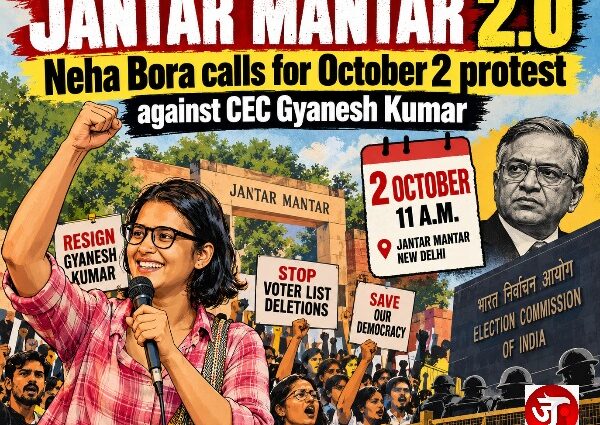
A fresh confrontation over India’s electoral rolls and the right to protest is taking shape in Delhi, with AISA president and JNU PhD scholar Neha Bora announcing “Jantar Mantar 2.0” for October 2 at 11 a.m., demanding the resignation of Chief Election Commissioner Gyanesh Kumar.
In a video posted on September 29, Bora declares, “Gyanesh, it’s done, bro!”, as footage shows a delegation including Bora and activist Yogendra Yadav submitting an intimation letter at the Parliament Street police station. The video also revisits the detention of protesters on September 25, when demonstrators attempting to reach Jantar Mantar were stopped by police while seeking to raise allegations surrounding the Special Intensive Revision (SIR) of electoral rolls.
The organisers say the October 2 mobilisation is being planned despite the police marking their letter “this is not permission.” Bora argues that the controversy has now moved beyond electoral-roll changes to what protesters describe as a second democratic restriction: first, concerns over who remains on the voters’ list, and then restrictions on where citizens can publicly protest those concerns.
The confrontation comes amid mounting scrutiny of the Election Commission following an Indian Express investigation reporting that Election Commissioners Sukhbir Singh Sandhu and Vivek Joshi had formally objected at least 14 times over 10 months to aspects of the poll panel’s handling of voter-roll changes, including issues involving new voters and deletion of names. The report said the commissioners described some moves as “unauthorised” and “illegal.
The Election Commission has rejected the broader allegations and has announced measures including a review of its ECINET software and changes intended to make the SIR process easier for voters. The Commission has also said that its SIR orders and schedules were unanimously approved, underscoring the sharp dispute between the protesters’ interpretation of the controversy and the ECI’s position.
The September 25 detentions have added another layer to the dispute. For the protesters, Jantar Mantar is not merely a location. It has become a test of whether citizens can publicly challenge an institution responsible for maintaining the electoral rolls. The authorities, meanwhile, have treated access and permissions according to their stated policing and administrative requirements.
At the centre of the storm is Gyanesh Kumar, who took charge as India’s 26th Chief Election Commissioner on February 19, 2025. A 1988-batch Kerala-cadre IAS officer, Kumar had earlier served as an Election Commissioner before becoming CEC.
With October 2 approaching, the battle is therefore no longer confined to a dispute over SIR paperwork. It has become a public contest over electoral transparency, institutional accountability and the space available for dissent on the streets of the capital. And, because apparently democracy occasionally requires citizens to argue with barricades as well as ballots, Jantar Mantar may once again become the stage.
At the same time, Jammu and Kashmir is witnessing a renewed political push for the restoration of full statehood. Chief Minister Omar Abdullah moved a resolution in the Assembly seeking the immediate restoration of statehood, arguing that the Union Territory arrangement has limited the powers of the elected government. The resolution was passed on September 28 amid sharp protests from BJP legislators, who said they support statehood but objected to references to Jammu and Kashmir’s pre-2019 constitutional position and earlier autonomy resolutions.
The debate has therefore reopened a much larger question about Jammu and Kashmir’s political status after the 2019 reorganisation, with the Assembly divided over whether the demand should focus solely on statehood or also encompass the region’s former special constitutional protections.
JANPATH NEWS NETWORK (JNN)
Independent. Fearless. On the People’s Path.