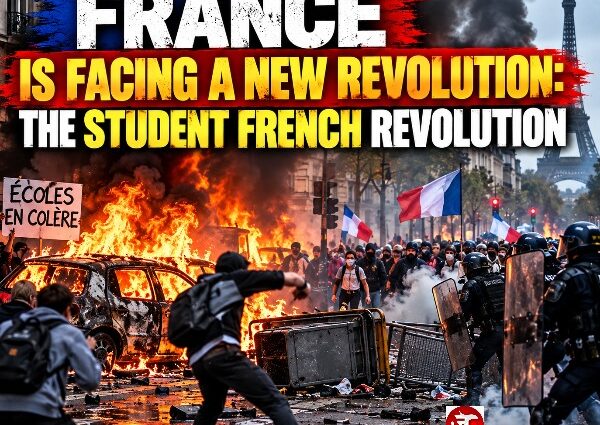
What began as a fight over teachers, overcrowded classrooms and crumbling schools has exploded into nationwide blockades, fires, clashes and mass arrests.
October 2, 2026: France is facing a rapidly escalating wave of high-school protests, with what began as a revolt over overcrowded classrooms, teacher shortages and deteriorating school buildings now spilling into streets, cities and the national political arena.
Hundreds of schools have been blockaded. Fires have been reported at school premises. Riot police have clashed with young protesters. Teachers and police officers have been injured. Thousands of people have been arrested or detained.
And the French government is now openly describing parts of the unrest as “urban violence.” Yet this is not simply another French street revolt. Unlike the nationwide suburban upheavals of 2005 or 2023, the current unrest remains fundamentally rooted in the education system. Its original demands are remarkably concrete: more teachers, smaller classes, better-maintained schools, adequate staff and less punishing schedules.
Right now, the school gates have become barricades. The barricades have become clashes. And the clashes are now threatening to overshadow the grievances that brought the students onto the streets in the first place.
From missing teachers to burning schools
The France high-school protests began in the Paris region and other parts of the country in September, as students returned to schools struggling with staff shortages and inadequate infrastructure. Students complained of absent teachers who were not replaced, overcrowded classrooms, lengthy timetables and buildings in poor condition.
The Union Syndicale Lycéenne, or USL, called for national mobilisation around demands including more teachers and staff, better school buildings, smaller classes and relief from overloaded schedules.
In some schools, students carried messages complaining that their school days were so long they had “more hours of lessons than sleep.”
Education Minister Édouard Geffray has acknowledged that some of the students’ grievances are legitimate, while drawing a firm line between legitimate protest and violence.
Then the protests exploded
By Thursday, the scale had changed dramatically. France’s Interior Ministry said actions had affected 1,027 educational establishments, with 222 schools blockaded. Police made 1,949 arrests during Thursday’s escalation.
Reuters reported that about 400 schools and other educational establishments were expected to remain closed on Friday, after authorities determined that conditions around some schools were unsafe.
The unrest has included fires at schools in Nantes and Rouen; damage to a school facade in Le Havre; a car being set alight in Strasbourg; clashes between youths and riot police; attacks involving projectiles; disruptions to public transport; teachers being splashed with petrol in Marseille; and injuries to students, teachers and police officers.
In one particularly disturbing incident in Marseille, officials said teachers were splashed with petrol when a student attempted to throw gasoline into a bin.
The violence has also spread geographically, with confrontations reported in cities including Toulouse, Lille, Reims, Marseille and the Paris region. At least one student suffered a serious hand injury after setting off a firework mortar, according to reporting on the unrest.
Nearly 2,000 arrests in one day
Authorities reported 1,949 arrests on Thursday alone, after earlier waves of detentions. Reuters put the total number arrested since the beginning of the movement at around 2,000, while other reporting has described nearly 3,000 lycée students as having been detained during the broader unrest. The exact totals vary depending on whether authorities are counting all arrests, students specifically, or cumulative detentions across different reporting periods.
The scale of the police response is itself becoming part of the political controversy. Students and left-wing politicians accuse the authorities of responding to legitimate youth grievances with excessive force.
The government, meanwhile, points to injured officers, burning schools, attacks, projectiles and the disruption of education.
Both realities are now part of the story.
Police and protesters trapped in an escalating cycle
Interior Minister Laurent Nuñez said the situation had moved beyond ordinary student demands and was displaying characteristics of urban violence. Prime Minister Sébastien Lecornu convened a crisis meeting as the protests intensified. His government faces a difficult problem. If police intervene aggressively, images of riot police confronting teenagers can further inflame anger.
The protests collide with France’s wider economic anger
The France high-school protests have also coincided with a separate public-sector strike. Teachers, hospital workers, civil servants and others have protested against government budget plans involving major spending reductions.
France’s political atmosphere was already tense because of the country’s difficult fiscal position and preparations for the 2027 presidential election.
The school protests have now added another layer of pressure.
The political fight: who is behind the unrest?
This is where the story becomes particularly contentious. According to a person close to Prime Minister Lecornu, intelligence agencies told a government crisis meeting that politicians from the hard left, including members of La France Insoumise (LFI), had helped initiate the protest movement.
The allegation has been rejected by LFI lawmakers. Jean-Luc Mélenchon and other LFI figures have said they support peaceful protest while accusing the government of using excessive force against young people.
That creates two competing narratives. The government’s narrative is that legitimate student anger is being politically exploited and pushed towards violence.
The LFI narrative is that the government is responding to legitimate grievances with repression. Neither claim should be treated as established fact without evidence.
What is indisputable is that the protests have become politically charged.
Saint-Denis becomes a flashpoint
Some of the most intense confrontations have occurred in poorer suburbs around Paris, particularly Saint-Denis.
The area has a long and complicated history of tension between residents and police, and the present protests are unfolding against that background. Saint-Denis mayor Bally Bagayoko has publicly supported the students’ grievances.
He also made comments suggesting that violence could at times be legitimate, prompting a complaint accusing him of incitement. That allegation is now part of the wider political confrontation surrounding the protests.
The government has seized on such statements as evidence that some political figures are encouraging escalation.
Critics argue that focusing exclusively on political actors ignores the underlying problems inside schools.
Again, the country is confronting two stories at once.
The government is trying to regain control
The government has not responded only with police. Authorities have also announced a consultation platform for high-school students, intended to allow young people to submit their concerns and demands.
That move reflects the government’s recognition that the original grievances cannot simply be dismissed. But the timing is awkward.
When students believe they have been ignored for months or years, a website asking them to describe their frustrations may not exactly feel like a revolution in public administration.
Meanwhile, schools are closing because authorities fear violence.
The next test: October 6
The student movement is not necessarily slowing down. The USL has called for another national mobilisation on October 6, potentially widening the protests beyond the current wave of school blockades. That date could become the next major test.
The question is whether the movement returns to its original demands or whether the violence becomes the defining feature.
If students continue peaceful blockades and demonstrations, the government will face pressure to address staffing, infrastructure and classroom conditions.
If fires, attacks and clashes continue, the government will have greater justification for treating the unrest as a public-order crisis.
And if police responses themselves produce more injuries or controversial incidents, the confrontation could deepen further.
France is facing a dangerous question
The most important fact about the France high-school protests is that they began with demands that are easy to understand.
Students wanted teachers, functioning schools, less overcrowding; buildings that did not feel neglected; and manageable schedules.
Those demands have now been partially buried beneath images of burning barricades, riot police, arrests and damaged schools.
That is the danger. When peaceful grievances become mixed with serious violence, governments gain a legitimate reason to focus on security, but again, when security becomes the only response, the original grievances can become even more explosive.
France therefore faces a difficult choice between restoring order and restoring trust.
JANPATH NEWS NETWORK (JNN)
Independent. Fearless. On the People’s Path.