Gandhi Jayanti is witnessing an unusual confrontation, political across two of India’s biggest cities, with Delhi and Mumbai becoming centres of protest over Chief Election Commissioner Gyanesh Kumar and the Special Intensive Revision (SIR) of electoral rolls.
October 2, 2026: The protests taking shape today are not the women’s-safety and student marches that dominated Delhi earlier this week. Those demonstrations were linked to reported cases of sexual violence and were led by student groups including SFI and Delhi University students.
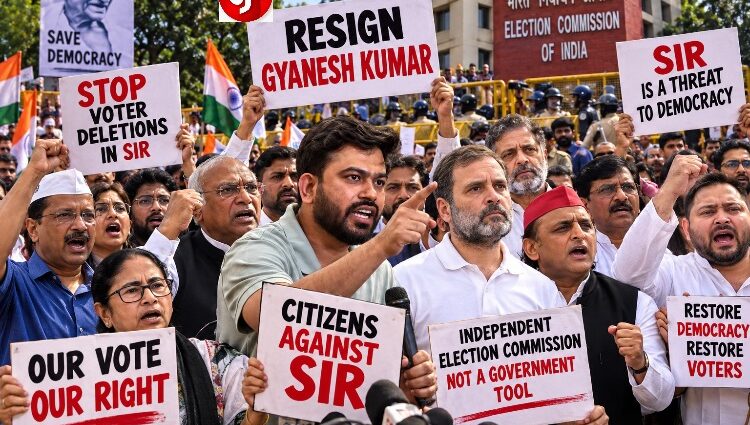
Today’s mobilisation has a different target: the Election Commission, Gyanesh Kumar, SIR and allegations concerning voter deletions. And, because apparently one national holiday was not complicated enough, both Delhi and Mumbai are now dealing with restrictions, barricades and heavy police deployment as competing claims over democracy, protest rights and electoral rolls collide.
Delhi: Jantar Mantar protest faces police restrictions
A protest against Gyanesh Kumar and the Election Commission was called for 11 am at Jantar Mantar by a combination of student, political and civil-society groups.
Those associated with the call include the All India Students’ Association (AISA), NSUI, Indian Youth Congress and Aam Aadmi Party members, along with RJD MP Manoj Jha and Supreme Court lawyer Prashant Bhushan. Delhi Police, however, did not grant permission for the gathering.
DCP Sachin Sharma said:
“Permission has not been granted for any type of protest, march at Jantar Mantar.”
He also pointed to Section 163 of the Bharatiya Nagarik Suraksha Sanhita (BNSS), under which assemblies of five or more people, processions, demonstrations, picketing and dharnas are prohibited without prior written permission in the affected New Delhi district. Slogan-shouting and speeches are also restricted.
Police have reportedly prepared for a turnout of several thousand people, with additional Delhi Police and CAPF personnel deployed around the protest zone.
11 Delhi Metro stations shut
The security response has spilled directly into the city’s transport network.
Entry and exit have been closed at 11 Delhi Metro stations until further notice. Interchange facilities remain available at several stations, including Rajiv Chowk, Mandi House, INA, New Delhi and Central Secretariat.
Traffic restrictions have also been imposed around Jantar Mantar, Parliament Street, Tolstoy Marg, Patel Chowk and adjoining areas.
What is driving the Gyanesh Kumar SIR protest?
At the centre of the dispute is the Special Intensive Revision (SIR) of electoral rolls. The controversy intensified after an Indian Express investigation reported that Election Commissioners Sukhbir Singh Sandhu and Vivek Joshi had raised objections on at least 14 occasions over roughly 10 months concerning aspects of electoral-roll management.
According to the investigation, the objections covered issues including the addition, deletion and restoration of voters, changes involving Form 6, access to electoral databases and oversight of systems connected to the rolls.
The investigation reported that more than 13 crore names had been struck from draft rolls across 30 states and Union Territories during the SIR exercise. That figure needs an important qualification: deletion from a draft roll is not automatically equivalent to permanent disenfranchisement, because the process includes mechanisms for claims, objections, restoration and appeals.
The Supreme Court has also previously intervened in the SIR process in relation to voters flagged for discrepancies, with judicial mechanisms subsequently involved in deciding disputed cases. The Indian Express reported last week that 38 lakh appeals were pending before tribunals, including more than 22 lakh filed by deleted voters seeking restoration.
The Election Commission’s response
The Election Commission has rejected the suggestion that internal differences amount to a breakdown in the institution. In its response to the reporting about dissent within the Commission, the ECI said differing views, written notes and technical observations are part of institutional deliberations and maintained that decisions relating to electoral-roll revision and SIR were ultimately unanimous decisions of the full Commission.
Mumbai: CJP takes the battle to Shivaji Park
Mumbai presents a different version of the same confrontation. The Cockroach Janta Party (CJP), led by Abhijeet Dipke, has called a 4 pm protest at Shivaji Park demanding action against Gyanesh Kumar and changes to the SIR process.
Unlike the Delhi mobilisation, this is not primarily a student-union protest. It is a political mobilisation led by CJP. Dipke and his colleagues have announced a “Jail Bharo Andolan” after Mumbai Police denied permission for the Shivaji Park gathering.
The police have cited restrictions arising from a 2013 Bombay High Court order and subsequent Maharashtra government guidelines governing the use of Shivaji Park. Police have also cited the absence of required BMC permission, the park’s silence-zone status, its residential surroundings and concerns about traffic and emergency access.
Dipke’s challenge: “CJP will not be a part of INDIA bloc protests”
Speaking at a Mumbai press conference, Dipke said the CJP movement would continue until Gyanesh Kumar resigns.
He also said:
“CJP will not be a part of INDIA bloc protests.”
Dipke appears to be separating the CJP from the INDIA bloc primarily to preserve the movement’s independent identity, rather than because he disagrees with the INDIA bloc’s opposition to Gyanesh Kumar.
Dipke says this is a citizens’ movement, not an opposition-party campaign
Dipke has explicitly said that CJP will not join the INDIA bloc’s protests, while simultaneously saying that he appreciates the INDIA bloc’s efforts against the Election Commission. The Indian Express reported his statement: “CJP will not be a part of INDIA bloc protests.”
He has also said that CJP will not take assistance from political parties and has urged protesters not to carry party flags or banners. His stated position is that the issue of electoral rights should rise above party politics.
Dipke has announced plans for further CJP mobilisations in Goa, Bengaluru and Kolkata, eventually aiming to bring the movement back to Jantar Mantar.
He has also called for greater transparency in the appointment of future election commissioners and argued that civil society should have a role in the process. Those are political demands made by the organisation, not established findings.
The CJP’s protest is also being watched because the group has increasingly become a visible youth-facing voice in the wider dispute over the Election Commission.
The Dipke detention confusion
There was also confusion over Dipke’s whereabouts ahead of today’s protest. Some reports initially suggested that he had been detained by Mumbai Police. CJP subsequently denied that he had been formally detained, with spokesperson Ashutosh Ranka saying Dipke was simply moving around Mumbai.
The episode illustrates another feature of today’s protests: information is moving almost as quickly as the protesters themselves, and claims of detention or police action need to be independently verified before being treated as fact. That is especially important when demonstrations themselves are about the credibility of institutions.
The wider political mobilisation
Today’s Delhi and Mumbai protests are also only part of a broader escalation.
The INDIA bloc has announced separate “Save Democracy” marches from October 2 to October 8, with district-level demonstrations planned outside district magistrates’ offices. Those events are separate from both the Jantar Mantar protest and the CJP’s Shivaji Park mobilisation.
Meanwhile, political leaders have intensified their criticism of the Election Commission and Gyanesh Kumar.
Congress leader Rahul Gandhi has reiterated demands concerning Kumar and sharply criticised the handling of SIR, while INDIA bloc leaders have called for Kumar’s removal and advocated using pre-SIR electoral rolls. The New
The Thackeray cousins, Raj and Uddhav, have also announced a joint protest concerning the functioning of the Election Commission for October 4.
So today’s events should not be viewed as an isolated Gandhi Jayanti demonstration, rather it should be viewed as a part of a growing confrontation over electoral institutions and voter rolls.
The most important story, therefore, is not whether Delhi or Mumbai produces the biggest crowd today. It is whether the country gets credible answers on how voter deletions are made, who authorises them, how mistakes are corrected and what safeguards prevent an eligible Indian citizen from losing the most basic instrument of democratic participation: the vote. Because barricades can control a street for a few hours. They cannot settle a question about the credibility of an electoral roll.
Sources: The Indian Express, Reuters, Times of India, Hindustan Times, Moneycontrol and other reports cited above.
JANPATH NEWS NETWORK (JNN)
Independent. Fearless. On the People’s Path.