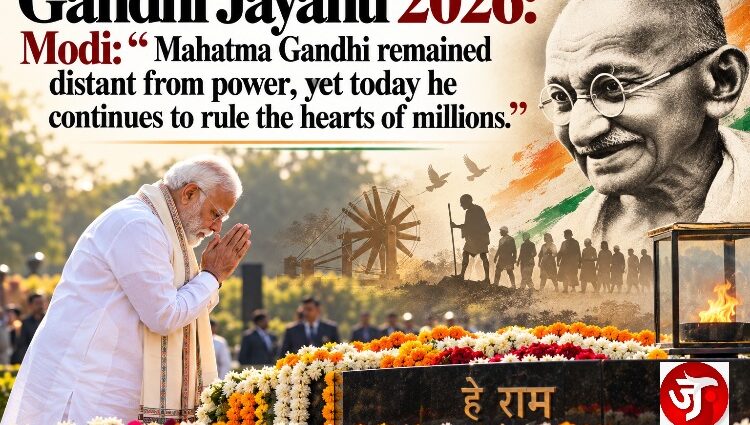
On Gandhi’s 157th birth anniversary, the Prime Minister pays tribute at Rajghat and urges citizens to embrace Khadi and Swadeshi, while President Murmu stresses the continuing relevance of peace and non-violence amid global conflicts.
October 2, 2026: The morning at Rajghat began in the language most closely associated with Mahatma Gandhi: prayer, silence and remembrance.
As the first light spread across the memorial, “Raghupati Raghav Raja Ram” rose over the lawns. The eternal flame burned steadily at the centre of Gandhi’s samadhi, surrounded by marigold and white flowers. Leaders, diplomats and citizens gathered for the Sarva-Dharma Prarthana Sabha as India marked the 157th birth anniversary of Mahatma Gandhi.
The occasion also carried a global significance. October 2 is observed by the United Nations as the International Day of Non-Violence, following the UN’s 2007 decision to designate Gandhi’s birthday for the worldwide observance.
Prime Minister Narendra Modi paid floral tribute at Rajghat and attended the interfaith prayer gathering. President Droupadi Murmu also paid homage to Gandhi. The day’s commemorations are being held alongside tributes to former Prime Minister Lal Bahadur Shastri, whose birth anniversary also falls on October 2.
Modi invokes Gandhi’s truth, compassion and Swadeshi
He said: “May Bapu’s timeless message keep guiding us towards a better society and a Viksit Bharat.”
In his video message, Modi also said:
“Mahatma Gandhi was such a person who remained distant from power, yet today he continues to rule the hearts of crores of people.
On Gandhi’s continuing relevance:
“I believe that as long as the impact of Gandhi Ji’s ideology remains with humankind, its inspiration and relevance will continue to remain among us.”
The Prime Minister also invoked a verse from the Bhagavad Gita describing the ideal of one who bears no hatred towards living beings and is friendly and compassionate towards all. The verse, from Chapter 12, is traditionally translated in terms of freedom from hatred, compassion, humility and forgiveness.
And on Khadi and Swadeshi:
“Gandhi Ji always promoted Swadeshi, and Khadi was one of its most prominent symbols. I would request you all to buy any Khadi product on October 2 and proudly say, ‘This is Swadeshi’.”
Modi separately described Gandhi’s life as:
“The entire life of revered Bapu is a beacon of truth, non-violence, compassion, and service that will continue to pave the way for humanity in every era.
He urged citizens to buy at least one Khadi product and celebrate it as an expression of Swadeshi. The appeal builds on his continuing emphasis on Khadi, handloom and indigenous production.
The symbolism is unmistakable: Gandhi’s spinning wheel and Khadi are being placed alongside the contemporary language of self-reliance and Viksit Bharat.
President Murmu: Gandhi’s message is even more relevant amid conflict
She said: “Today, an atmosphere of war and conflict prevails in many parts of the world, affecting all nations. In these circumstances, Mahatma Gandhi’s message of peace and non-violence becomes even more relevant.”
On Gandhi’s idea of Sarvodaya, she said:
“This vision reflects the spirit of Mahatma Gandhi’s ideal of ‘Sarvodaya’, based on the principle of the welfare and upliftment of all.”
And she concluded with a call for:
“building an empowered, developed and Atmanirbhar Bharat through our ethical conduct and active participation.”
At Rajghat, the politics of the day briefly gives way to something older and quieter when the flowers bloom and prayers drone, surrounded by the names of different faith traditions heard together. And at the centre of it all is the black marble platform marked simply by the words “Hey Ram.”
Gandhi’s political legacy has been debated, challenged and interpreted in radically different ways across generations. But every October 2, the country returns to this memorial and repeats the central vocabulary of his public life: truth, non-violence, service, simplicity and communal harmony.
Gandhi’s legacy remains impossible to erase
There is another significance to Gandhi Jayanti 2026 that cannot be missed. In recent years, Gandhi’s place in India’s political and historical conversation has increasingly been contested, with sections of public discourse seeking to diminish Gandhi while giving greater prominence to other figures of the freedom movement, including V.D. Savarkar. There have also been repeated controversies and public debates around the glorification of Gandhi’s assassin, Nathuram Godse. These competing narratives have made every Gandhi Jayanti more than a ceremonial remembrance.
But Gandhi Jayanti 2026 presented a striking counterpoint. At Rajghat, the country’s highest constitutional authorities gathered to honour Gandhi, while Prime Minister Narendra Modi described Gandhi’s life as a continuing beacon of truth, non-violence, compassion and service. Modi also said that Gandhi’s timeless message should continue guiding India towards a better society and a Viksit Bharat.
President Droupadi Murmu went further in placing Gandhi’s philosophy in the context of the present world, saying that with war and conflict affecting many parts of the world, Gandhi’s message of peace and non-violence has become even more relevant.
Whatever the political arguments of the past few years, the symbolism of Gandhi Jayanti 2026 was unmistakable: Gandhi’s name, his memorial, his philosophy and his message once again occupied the centre of the national stage. The arguments around history may continue, but Gandhi’s presence in India’s public memory has proved extraordinarily difficult to dislodge.
There is something almost stubborn about the ritual. It remains eternal in the turbulent rise and fall of governments, amid political battles. While the news rooms churn up dramatic news and fight virulently, the flame at Rajghat, irritatingly indifferent to the cycle of change and argument, keeps burning. Political narratives come and go. Gandhi remains..
JANPATH NEWS NETWORK (JNN)
Independent. Fearless. On the People’s Path.