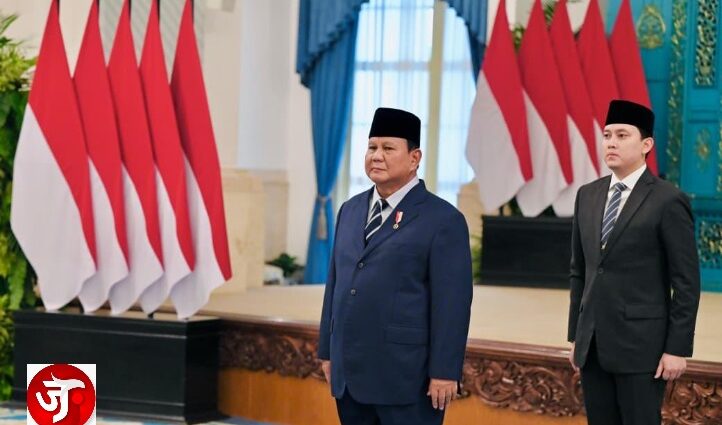
Prabowo replaces Sugiono with veteran diplomat Arrmanatha Nasir as Jakarta navigates an increasingly complex world
October 1, 2026: Indonesia has quietly made a change at the top of its foreign-policy machinery that could have consequences far beyond Jakarta.
President Prabowo Subianto has appointed career diplomat Arrmanatha Christiawan Nasir as Indonesia’s new foreign minister, replacing Sugiono in a cabinet reshuffle announced on Thursday.
Nasir, a veteran diplomat and former Indonesian representative to the United Nations, previously served as deputy foreign minister. His appointment places a highly experienced career diplomat at the centre of Indonesia’s international engagement at a time when Jakarta is balancing relationships with major powers and expanding its role in multilateral groupings.
The change is significant not simply because one minister has replaced another, rather, it comes as Indonesia’s foreign policy is being tested by a rapidly shifting Indo-Pacific landscape involving China, the United States, ASEAN, BRICS and competing strategic interests across the region.
Nasir is a career official from Indonesia’s foreign ministry. Before becoming deputy foreign minister in 2024, he held a series of senior diplomatic positions, including representing Indonesia at the United Nations. He was formally sworn in at the State Palace in Jakarta on October 1 under Presidential Decree No. 105/P of 2026.
His predecessor, Sugiono, has been moved to the position of Coordinating Minister for Human Development and Culture. Reuters described Nasir’s appointment as Prabowo’s second major senior cabinet change in less than three weeks.
That timing has attracted attention because the reshuffle comes as Prabowo’s government is making broader adjustments to its cabinet and the way major areas of policy are managed.
But is Indonesia actually changing direction?
This is where the story becomes more interesting. There is currently no indication of an abrupt foreign-policy reversal. In fact, Nasir himself has stressed continuity. After his inauguration, he said Indonesia would continue implementing the foreign-policy direction established under Prabowo and pursued by Sugiono. He also reiterated Indonesia’s constitutional commitment to an independent and active foreign policy.
That means the immediate story is not necessarily that Indonesia is abandoning one geopolitical camp for another.
Instead, the question is whether a veteran diplomatic establishment figure will change how Jakarta executes the president’s foreign-policy priorities.
Reuters reported that analysts had viewed Indonesia’s foreign ministry as having been overshadowed by Prabowo’s increasingly direct role in foreign affairs. Nasir’s appointment could give the ministry a more prominent professional diplomatic voice.
Why the world should watch Indonesia
Indonesia is not just another Southeast Asian country. It is the region’s largest economy and a major ASEAN power, with extensive economic and diplomatic relationships across the Indo-Pacific. Jakarta has simultaneously sought engagement with China and the United States, maintained its central role in ASEAN and strengthened its involvement in BRICS.
Under Sugiono, Indonesia joined BRICS and participated in international initiatives involving the Gaza conflict. Nasir has indicated that Indonesia will continue its existing international commitments rather than abruptly changing course.
The balancing act is becoming increasingly complicated. China is a major economic partner. The United States remains a crucial strategic and economic power in the Indo-Pacific. ASEAN expects Indonesia to play a significant regional role. Meanwhile, Indonesia is seeking a larger voice in institutions beyond Southeast Asia.
The South China Sea plays a huge role, where maritime disputes and competition between major powers continue to shape the regional security environment.
Indonesia therefore has to maintain relationships with countries that increasingly find themselves on opposite sides of major geopolitical questions.
Nasir’s diplomatic experience may also matter because Indonesia is pursuing a future role at the United Nations. The new foreign minister has confirmed that Jakarta will continue its campaign for a non-permanent seat on the UN Security Council for 2029–2030.
That fits with Indonesia’s broader effort to present itself as an influential middle power capable of engaging across competing blocs. Nasir’s previous experience at the UN gives him direct familiarity with precisely the kind of multilateral diplomacy Indonesia will need as it seeks to expand its international role.
A quiet change with a larger question behind it
For now, Indonesia’s message is continuity. Nasir has explicitly said that he intends to continue the foreign-policy direction established under Prabowo. But personnel changes matter, particularly when the person taking over is a career diplomat with extensive international experience.
The coming months will show whether Nasir’s appointment simply strengthens the machinery carrying out Prabowo’s existing policy, or whether his diplomatic style gives Indonesia’s foreign ministry a greater institutional role.
Either way, Jakarta is making the change at a consequential moment. As Washington and Beijing compete for influence, ASEAN confronts mounting strategic pressures, BRICS expands its reach and conflicts continue to reshape global diplomacy, Indonesia is positioning itself to remain engaged with multiple sides rather than being confined to one geopolitical camp.
The appointment of Arrmanatha Nasir may therefore look like a routine cabinet change, or it may turn out to be something more subtle: Indonesia is not necessarily changing its foreign-policy direction. It may be changing the diplomat who will help steer it through an increasingly fractured world.
JANPATH NEWS NETWORK (JNN)
Independent. Fearless. On the People’s Path.