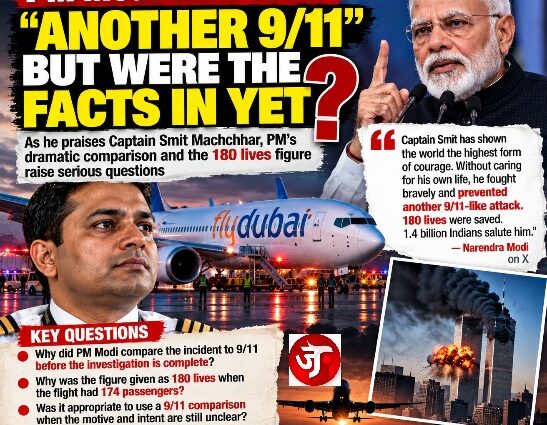
Captain Smit Machchhar’s courage is beyond question. The Prime Minister’s dramatic comparison, however, raises questions about timing, terminology and the numbers being reported.
October 1, 2026: Captain Smit Machchhar’s courage aboard Flydubai Flight FZ1073 has earned widespread praise. Seriously injured during a violent cockpit confrontation, the Indian captain helped open the cockpit door, allowing passengers and crew to intervene before the aircraft was diverted safely to Tabuk, Saudi Arabia.
But as investigators continue to examine exactly what happened inside that cockpit, Prime Minister Narendra Modi has invoked one of the most consequential terrorist attacks in modern history: September 11, 2001. Addressing the centenary celebrations of the Union Public Service Commission on Thursday, Modi said that Machchhar had demonstrated remarkable presence of mind and courage and referred to the Israeli Prime Minister’s description that “an Indian saved us from a 9/11.”
Exact words from his speech are: “In the incident that occurred yesterday, Captain Smit of India demonstrated remarkable patience, presence of mind, and courage; indeed, as the Prime Minister of Israel stated today, an Indian prevented a 9/11-style tragedy.”
The comparison immediately raises a difficult question: Was it too early to invoke 9/11 when the circumstances, motive and intent behind the Flydubai cockpit attack were still under investigation?
Flight FZ1073 was travelling from Dubai to Tel Aviv when a violent confrontation reportedly erupted between the pilots. The co-pilot allegedly stabbed Machchhar, after which the aircraft went into a rapid descent of nearly 14,000 feet in less than 30 seconds, according to Reuters.
Despite his injuries, Machchhar managed to unlock the cockpit door. Passengers and crew then intervened and overpowered the attacker, while other pilots aboard the aircraft helped land the plane in Tabuk.
There is therefore ample evidence for describing Machchhar’s actions as courageous and for saying that a potentially catastrophic aviation disaster was averted.
But a potential aviation disaster and another 9/11 are not automatically the same thing.
What does ‘9/11’ actually imply?
The September 11 attacks were a coordinated terrorist operation involving the hijacking of four commercial aircraft by al-Qaeda and the deliberate use of those aircraft as weapons, killing nearly 3,000 people.
The Flydubai incident, based on the information publicly available so far, involved an alleged violent attack by one pilot against another, followed by a rapid loss of altitude, intervention by passengers and crew, and an emergency landing.
Authorities are investigating the co-pilot’s motive and the precise sequence of events. Flydubai has urged against premature speculation, saying the underlying reasons for the incident remained unknown and were subject to investigation.
Calling the incident “9/11-like” is a powerful description. It suggests not merely that a plane was in danger, but that the incident represented an attack of a particular terrorist character and scale. Those are conclusions investigators are still working to establish.
Modi was referring to Netanyahu, but the question remains
There is another important detail in Modi’s wording. The Prime Minister did not present the 9/11 comparison as a finding from an Indian investigation. He explicitly attributed it to Netanyahu, saying that “as the Prime Minister of Israel said, an Indian saved us from a 9/11.”
Netanyahu himself had praised Machchhar for helping prevent what he described as a catastrophic mid-air disaster. But attribution does not eliminate the underlying question.
That is a legitimate question for journalism, particularly when the historical comparison carries enormous political and emotional weight.
The second discrepancy is more straightforward. Multiple reports have circulated the figure 180, including headlines describing Machchhar as having saved 180 lives.
But Reuters reported that the flight carried 174 passengers, and Netanyahu specifically referred to Machchhar saving the lives of 174 people. Reuters and other reports also identify the flight as carrying 174 passengers.
Other reports have used “around 180” or “nearly 180”, apparently reflecting a broader count that may include crew. That may explain how the larger figure entered early reporting.
But there is a crucial distinction between saying 174 passengers and saying 180 lives. The number itself does not diminish Machchhar’s actions.
But public statements by political leaders are not ordinary breaking-news social media posts. Numbers and descriptions can quickly become part of the permanent public record. A difference of six people may appear trivial, yet in a story about an alleged attempt to bring down a passenger aircraft, it isn’t.
The investigation now needs to establish why the confrontation happened, what the co-pilot intended, how control of the aircraft was compromised, and whether the episode should ultimately be classified as an attempted hijacking, an attempted crash, a terrorist act or something else.
Until those questions are answered, the language surrounding the incident deserves the same caution as the investigation itself.
The 9/11 comparison is now part of the public conversation because India’s Prime Minister repeated it. The figure of 180 has also circulated widely, despite reporting that identifies 174 passengers aboard the flight.
When a disaster is narrowly avoided, should political leaders wait for investigators to establish what happened before attaching the language of terrorism and 9/11 to it?
JANPATH NEWS NETWORK (JNN)
Independent. Fearless. On the People’s Path.