









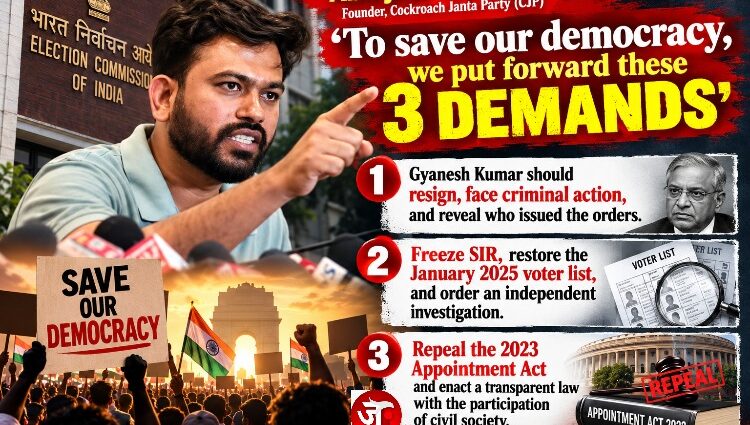
The confrontation over India’s electoral rolls has entered a more intense phase, with Abhijeet Dipke, founder of the Cockroach Janta Party (CJP), putting forward three demands centred on Chief Election Commissioner Gyanesh Kumar, the Special Intensive Revision (SIR) of electoral rolls and the law governing the appointment of Election Commissioners.
Speaking to the media, Dipke said the CJP would continue its campaign demanding Kumar’s resignation and announced protests if the demands were not met. The organisation has framed the issue as a larger fight over the right to vote, electoral-roll transparency and institutional accountability.
Three demands, one central question: who controls the voter list?
The CJP’s first demand is uncompromising: Gyanesh Kumar should resign, face criminal proceedings and answer who authorised the decisions that the organisation is challenging.
Dipke has alleged that the electoral process is being compromised and has questioned how decisions affecting voters are being made. These are allegations advanced by the CJP and should not be treated as established findings unless independently established through an investigation or judicial process.
The second demand goes directly to the SIR exercise.
The CJP wants SIR frozen, upcoming elections halted pending the dispute, and the electoral rolls restored to the January 2025 position while an independent investigation examines the decisions behind the revision process. The organisation has also called for relevant records to be preserved for independent scrutiny.
For Dipke, the issue is not merely administrative. It is about whether citizens whose names disappear from electoral rolls have an effective and transparent mechanism to challenge those decisions.
The third demand goes after the appointment system
The CJP’s third demand reaches beyond the immediate SIR controversy.
It is calling for the repeal of the 2023 law governing the appointment of the Chief Election Commissioner and other Election Commissioners, followed by a new framework that, in its formulation, would involve wider institutional and civil-society participation.
That makes the campaign substantially broader than a demand for one official’s resignation. It raises questions about how India’s election commissioners are appointed, how electoral rolls are revised and what safeguards exist when citizens challenge changes to their voting eligibility.
The controversy inside the Election Commission
The CJP’s campaign follows reporting about differences within the Election Commission concerning aspects of the SIR process.
The Indian Express reported that Election Commissioners Sukhbir Singh Sandhu and Vivek Joshi had recorded objections on multiple occasions concerning decisions and orders related to SIR. The Election Commission, however, has maintained that differing views and written observations are part of its internal deliberative process and has said decisions over the past year, including SIR-related decisions, were unanimous.
‘Jantar Mantar 2.0’
Dipke has warned that the CJP will escalate its protests if Kumar does not resign, describing a possible Delhi mobilisation as “Jantar Mantar 2.0.” The organisation has also announced a nationwide campaign around its demands.
The campaign now places a stark question before India’s electoral institutions: When a voter’s name is removed from an electoral roll, who is accountable, what evidence supports that decision, and what independent mechanism allows that voter to challenge it?
Those questions can be answered only through documentary evidence, transparent procedures, judicial scrutiny where applicable and publicly verifiable electoral data.
For the CJP, however, the answer is already political: the fight over SIR is a fight over the vote itself.
And that is why Dipke’s three demands have pushed the Gyanesh Kumar controversy beyond one individual’s tenure and into a much larger argument about electoral rolls, institutional independence and public confidence in India’s election machinery.
JANPATH NEWS NETWORK (JNN)
Independent. Fearless. On the People’s Path.