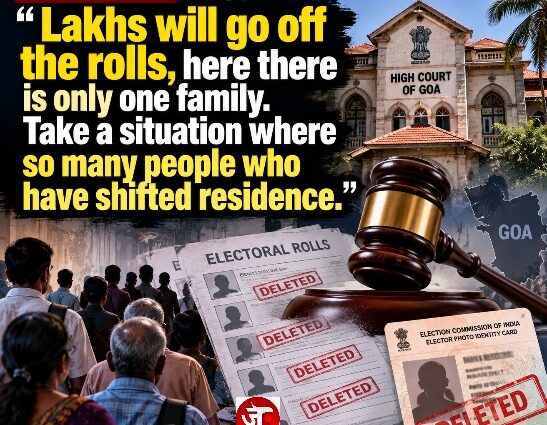
Six-member family caught in electoral software problem after moving house, prompting court to ask whether technology has been allowed to override procedure
September 20, 2026: What happens when a voter follows the procedure laid down by the Election Commission, but the election system itself refuses to recognise the application?
That question came sharply into focus before the Bombay High Court at Goa this week after six members of a family found themselves removed from the electoral rolls while attempting to update their address.
The case has prompted the court to question not only the functioning of the Election Commission’s software, but also the larger administrative process through which voters are added, shifted or removed from electoral rolls.
They moved house and the problem began with Form 8. The petition was filed by Paresh Salgaoncar and five members of his family, who had shifted residence within the same Santa Cruz Assembly constituency. Following instructions from the Booth Level Officer, the family submitted Form 8, the prescribed form for an existing elector seeking a change of address. But when the applications were processed, the system reportedly showed that their EPIC records could not be found.
According to the petitioners, the software offered officials no meaningful route to process the applications. The only available option in the relevant system was reportedly to reject them. They were subsequently informed that their names had already been deleted from the electoral rolls.
The family was then advised to submit Form 6, the application ordinarily used by a person seeking fresh inclusion in the electoral roll. That was where the dispute became more than a technical problem.
The petitioners argued that Form 6 was inappropriate because they were not new voters. They were already registered electors and were seeking only to change their address within the same constituency. Form 8 exists precisely for that purpose.
The judges questioned why an existing elector should suddenly be treated as a new applicant simply because the software could not process Form 8. The bench observed that the system had effectively created a situation in which “he was never a new voter” but became one for the purposes of the software.
The Election Commission’s position, as reported during the hearing, was that the system did not permit Form 8 applications to be processed during the relevant enumeration phase of the Special Intensive Revision.
The court, however, questioned why an administrative software restriction should prevent officials from applying the procedure prescribed for existing electors.
The court’s bigger question: who controls the process?
The judges went beyond the family’s individual case. They questioned whether the draft electoral roll could itself be treated as sufficient basis for deleting names and asked the Election Commission to identify the legal provision that permits deletion without the required process and opportunity for hearing.
The bench also questioned whether election officials had become effectively powerless when confronted with a software limitation.
In substance, the court’s concern was this: If the law gives an election officer the authority to decide a voter’s status, can a computer system prevent that decision from being recorded or implemented?
The judges described themselves as concerned about the possibility that the same problem could affect many other voters who may never approach a court.
But the court pointed to the obvious question: if such a problem can occur to six voters who happened to challenge it, how many others might encounter a similar problem without knowing why their names have disappeared?
This exposes a potentially serious administrative vulnerability: the gap between what election law permits, what officials are supposed to do and what a digital system actually allows them to do.
Goa has already seen software-related voter concerns. The latest hearing comes against the backdrop of earlier controversy in Goa involving voters left out of electoral rolls because of problems associated with the election software.
The Election Commission has said that eligible voters will not be left behind and has reported steps to contact and process affected electors. In one earlier Goa episode involving 97 voters, the commission said that many had subsequently been enrolled after follow-up action.
The Commission has also maintained that its electoral-roll revision process includes mechanisms for voters to seek inclusion or correction.
Those assurances are now being tested against a more fundamental question raised in court: what happens when the mechanism itself does not allow the legally prescribed application to move forward?
It is unfortunate that a technology question is becoming an election question because India’s electoral machinery increasingly depends on digital systems to maintain enormous databases of voters. While, this technology can make elections and voter administration faster and more manageable, the Goa case highlights the other side of digitisation, such as database does not understand rights, legislation and an automated workflow cannot, by itself, replace the statutory responsibility of an election officer.
If in an electoral system when a single missing name can determine whether a citizen gets to cast a ballot, is it a system to use at all?
JANPATH NEWS NETWORK (JNN)
Independent. Fearless. On the People’s Path.