The events around October 2, Gandhi Jayanti, are beginning to look less like a single protest and more like a widening national mobilisation around questions of electoral integrity, voting rights and the functioning of the Election Commission.
New Delhi/Mumbai: A new phase of street mobilisation is taking shape in India as student groups, civil-society activists, opposition parties and the youth-led Cockroach Janta Party (CJP) prepare demonstrations on October 2, Gandhi Jayanti, centred on allegations concerning the Election Commission’s handling of electoral-roll revisions and the Special Intensive Revision (SIR) exercise.
The immediate flashpoint is Chief Election Commissioner Gyanesh Kumar. Activists and opposition parties are demanding his resignation or impeachment and questioning the manner in which voter rolls have been revised. The Election Commission, for its part, says its actions have followed the law and has ordered a review of its voter-roll software after reports raised questions about changes to electoral rolls.
And now October 2 has acquired a second dimension: the streets themselves are becoming the battleground over the right to protest.
From Jantar Mantar to Shivaji Park
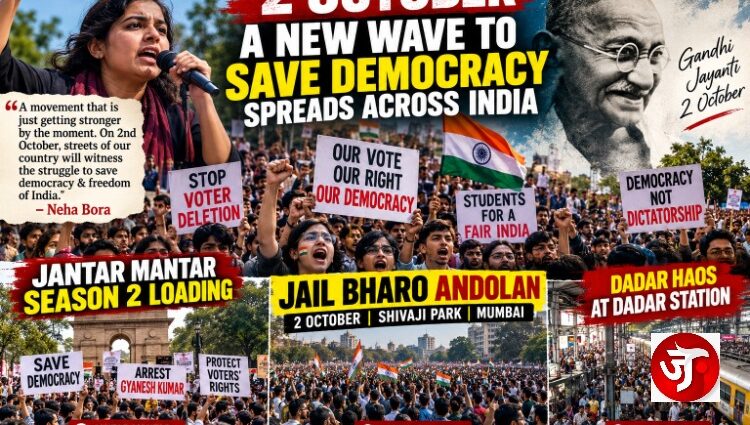
On September 25, a protest called by the All India Students’ Association (AISA) at Jantar Mantar ended with more than 60 people being detained, including student leader Neha Bora, Yogendra Yadav, Prashant Bhushan, Anjali Bhardwaj and CPI(M) leader Dipankar Bhattacharya. Police said the gathering lacked the required permission and that restrictions on assembly were in force in New Delhi. The protesters were subsequently released.
That episode has become part of the mobilisation leading into October 2 where Neha Bora is now among the organisers calling for another protest at Jantar Mantar on Gandhi Jayanti. The organisers say they want accountability from the Election Commission and have raised concerns about the protection of citizens’ voting rights.
In Mumbai, the confrontation has taken another turn. CJP founder Abhijeet Dipke says his organisation will proceed with an October 2 protest at Gate 6 of Shivaji Park, Dadar, despite Mumbai Police denying permission. After the denial, he announced a “Jail Bharo Andolan”.
Police have cited restrictions governing the use of Shivaji Park, including a 2013 Bombay High Court order and a subsequent Maharashtra government resolution. Authorities have also pointed to the absence of required BMC clearance, traffic concerns, noise restrictions and the presence of hospitals in the surrounding area.
So there are now two competing claims of democratic space: protesters say restrictions are suppressing dissent; authorities and local residents say the location, traffic, noise and emergency access must also be protected.
Why the youth question matters
What makes this moment particularly significant is the visible participation of student and younger activist groups. The September Jantar Mantar demonstration was organised by Cockroach Janta Party, AISA joined, where Neha Bora has emerged as one of the prominent young voices in the mobilisation. CJP has also built a substantial social-media campaign around October 2, describing the day as the beginning of a wider movement.
The INDIA bloc has separately announced “Save Democracy” marches from October 2 to 8 across districts, with plans to involve youth and NGOs, followed by a march by parliamentarians to the Election Commission’s office in Delhi on October 6. That is important because it means the issue is no longer confined to one organisation or one protest venue.
The controversy began with the voter-roll question
At the centre of the dispute is reporting by The Indian Express about internal disagreements within the Election Commission concerning changes to electoral rolls.
Reuters reported that two Election Commissioners had raised questions or concerns before CEC Gyanesh Kumar on at least 14 occasions over ten months, while the Election Commission subsequently ordered a review of the voter-roll software. The opposition and activist groups interpret those developments as evidence of serious threats to electoral integrity.
The Election Commission rejects that interpretation, saying institutional differences are normal and that its actions have been lawful. It has also announced that a committee including a senior election official and an independent technology expert will examine whether the software complies with election laws and rules. Reuters
Dadar becomes the next flashpoint
The tension in Mumbai is particularly striking because Shivaji Park is not an ordinary piece of public ground. It has enormous political and cultural significance, having hosted major public gatherings for decades.
Residents have opposed the proposed October 2 gathering, citing schools, hospitals, children using the ground and traffic problems. Some residents have also alleged that previous gatherings caused severe congestion. These are claims from residents rather than independently established findings.
And then there is Jantar Mantar 2.0: In Delhi, activists are preparing another mobilisation at Jantar Mantar for October 2, although Delhi Police had not granted permission as of September 30.
That gives the coming Gandhi Jayanti protests an unusual symbolism. Gandhi’s politics was built around the idea that citizens could challenge authority through mass, organised and non-violent resistance.
More than seven decades after independence, a new generation of protesters is invoking that tradition while confronting a very different India: one where battles over electoral rolls, technology, institutions, social media and the right to assemble are increasingly intertwined.
There is clear evidence of increasing youth and civil-society mobilisation around the Election Commission controversy, repeated protests, detentions and preparations for larger demonstrations on October 2.
October 2 is no longer merely a date on the calendar. It has become a test of how far a new generation is prepared to take its demand for electoral accountability into the streets, and how the state responds when that demand collides with restrictions on public assembly.
JANPATH NEWS NETWORK (JNN)
Independent. Fearless. On the People’s Path.