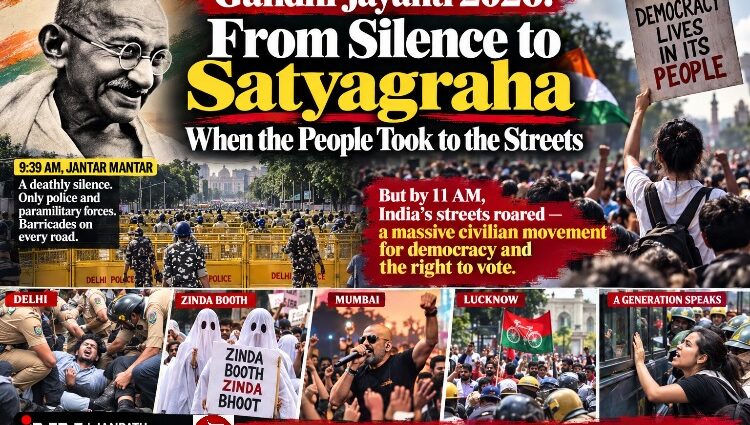
From a silent, barricaded Jantar Mantar to packed streets in Mumbai and protests in Lucknow, Gandhi Jayanti 2026 became a day of detentions, dissent and civilian mobilisation over the right to vote.
October 2, 2026: Gandhi Jayanti 2026 began in Delhi with an image that was almost the opposite of the Gandhi most Indians remember: not crowds, slogans and spinning wheels, but barricades, police vehicles and an unusually silent Jantar Mantar. By around 9.39 am, videos from the protest zone showed a heavily secured area, with police and paramilitary personnel positioned around the roads leading towards the designated protest site. In Mumbai, the Cockroach Janta Party (CJP), student groups and civil-society activists had called people to gather around 11 am to demand action against Chief Election Commissioner Gyanesh Kumar over the Election Commission’s handling of the Special Intensive Revision (SIR) of electoral rolls.
Delhi Police had denied permission for the proposed Jantar Mantar demonstration and imposed prohibitory restrictions in the New Delhi district. Security was tightened across central Delhi, with barricades, additional forces and restrictions on movement around the protest area.
But what unfolded through the day was bigger than a confrontation between political organisations and the police. The Gandhi Jayanti 2026 protest increasingly took the shape of a civilian mobilisation, with students, young professionals, activists, actors, singers, political workers and ordinary citizens gathering in different parts of central Delhi despite the restrictions.
By afternoon, Delhi Police said more than 700 people had been detained. The Indian Express reported that protesters arriving from Ashoka Road, Janpath and Tolstoy Road were stopped, placed into buses and taken to police stations including Fatehpur Beri and Badarpur. Among those detained were AAP leaders, former Delhi Chief Minister Atishi, Rajya Sabha MP Sanjay Singh, RJD leader Manoj Jha, AISA president Neha Bora and activist Yogendra Yadav.
The scale of the detentions became one of the defining images of Gandhi Jayanti 2026. At one point, The Indian Express reported that police officers were watching groups of protesters near Janpath and discussing whether to put them into buses if they gathered in groups larger than ten. The newspaper described the area around Jantar Mantar and Parliament Street as having been sealed before a large crowd could assemble.
From Gandhi’s satyagraha to today’s street protest
The striking symbolism was impossible to miss. Gandhi’s political method depended on ordinary people entering public life through non-violent resistance. Champaran in 1917 transformed a local grievance over indigo cultivation into a national political moment. The Salt March of 1930 turned an everyday commodity into a symbol of resistance and brought thousands of ordinary Indians into the freedom struggle. The Quit India movement of 1942 again demonstrated how political resistance could move far beyond established political leadership.
The protesters of Gandhi Jayanti 2026 were not reproducing those movements, and the political circumstances are entirely different. But the symbolism of civilians entering the streets to defend what they regard as their democratic rights was unmistakable.
That is why the scenes from Delhi carried such force.
Yogendra Yadav, after being detained, drew a direct comparison with the colonial era, saying from inside a police bus: “This government is acting like the British government.” His statement was a political comparison, not a historical equivalence, but it captured the mood of protesters who saw the heavy deployment and mass detentions on Gandhi Jayanti as deeply ironic.
The historical comparison also has a darker side. The British Raj used extraordinary state force against political mobilisation, from the arrests of nationalist leaders to the Jallianwala Bagh massacre of 1919, when British troops fired on an unarmed gathering. Gandhi subsequently turned incidents of state repression into arguments for mass non-cooperation and satyagraha.
The Delhi events of 2026 were nowhere near the scale or historical character of colonial atrocities such as Jallianwala Bagh. But protesters themselves invoked the language of the Raj to describe what they regarded as excessive policing.
The question at the centre: who gets to vote?
Behind the slogans against Gyanesh Kumar lies a larger dispute over the electoral rolls. The controversy centres on the Election Commission’s Special Intensive Revision of voter lists. Critics have alleged that the process has resulted in eligible voters being left out or removed. The Election Commission has defended the exercise as a process intended to identify duplicate, deceased or otherwise ineligible voters.
The dispute gained further momentum after The Indian Express reported that Election Commissioners Sukhbir Singh Sandhu and Vivek Joshi had raised objections on at least 14 occasions over a 10-month period concerning decisions and procedures connected with SIR, voter registration and the Commission’s digital systems. The Election Commission has said that differing views are normal within internal deliberations.
Among the most visible faces of the Delhi protest was AISA president Neha Bora. After being detained, Bora criticised the police action and argued that the attempt to prevent protesters from gathering would not end the movement. In a statement circulated on social media, she said: “You can try to silence dissent, but you cannot silence the people.” Her broader message focused on democracy, accountability and the right to vote.
Her presence alongside students and activists was significant because the day was not confined to established political parties. The Indian Express described small groups of college students, middle-aged men and women and other citizens continuing to gather around Janpath even after Jantar Mantar had been sealed. One protester told the newspaper that the issue went beyond Gyanesh Kumar and concerned what he described as the disenfranchisement of voters. Another said he regarded protesting for accountability as his civic duty.
The protest was political, but it was not exclusively partisan.
“Zinda Booth”, buses and a Gen-Z protest culture
The protest also displayed a distinctly new political language. The Indian Youth Congress used a theatrical device dubbed “Zinda Booth”, with activists dressed as ghosts to dramatise fears surrounding voter deletions. The symbolism was deliberately visual: a “booth” without voters, and voters who feared disappearing from the electoral roll.
Young protesters also turned police buses into moving stages of resistance, shouting slogans and recording videos from inside them.
One of the day’s most striking viral moments showed a young woman attempting to stop a bus carrying detained protesters. The image captured the generational character of the demonstrations: young citizens confronting a heavily fortified state apparatus using little more than their bodies, phones, slogans and cameras.
Videos of detentions, barricades and clashes travelled rapidly, while supporters repeatedly gathered near police stations and other locations where protesters had been taken. Some detainees were subsequently released, keeping the demonstrations moving from one location to another.
The result was a protest that could not be contained entirely within the boundaries of Jantar Mantar.
The Gandhi Jayanti 2026 protest was also national in character. In Lucknow, Samajwadi Party workers staged a protest at Hazratganj demanding Gyanesh Kumar’s resignation. Heavy police deployment followed, and protesters were taken into custody and moved to Eco Garden, according to reports.
In Delhi, the Indian Youth Congress has separately organised protests demanding Kumar’s resignation, with national president Uday Bhanu Chib repeatedly accusing the CEC of responsibility for what the party alleges are wrongful voter deletions.
At Shivaji Park, the CJP held its Gandhi Jayanti protest despite police denying permission. Hundreds gathered, according to Reuters, while the movement’s organisers announced plans to take the campaign to other cities including Goa, Kolkata and Bengaluru.
The Mumbai gathering also produced some of the day’s most unexpected images. Actor Naseeruddin Shah met CJP founder Abhijeet Dipke, hugged him and told him he wanted to thank him. Dipke later posted, “Am I dreaming or what?”
Singer Vishal Dadlani joined the Mumbai protest, while actors Shabana Azmi and Prakash Raj also publicly expressed support. Dadlani told the gathering that the movement would continue, while Azmi framed the dispute around a simple question: what happens when a citizen’s name disappears from the voter list?
These appearances gave the movement a cultural dimension, but the larger crowd remained overwhelmingly made up of ordinary protesters.
The rhetoric surrounding the protests was unusually sharp.
Yogendra Yadav: “This government is acting like the British government,” he said from a police bus, linking the day’s policing to the symbolism of Gandhi Jayanti.
Neha Bora: She argued that attempts to silence dissent would not silence citizens and emphasised democracy, accountability and voting rights.
Uday Bhanu Chib: The Indian Youth Congress president has repeatedly demanded Kumar’s resignation and warned that the campaign would continue.
Pawan Khera: The Congress spokesperson questioned the government’s support for Kumar, writing: “Why would the BJP government work tooth and nail to save Gyanesh Kumar Gupta’s chair if he weren’t their own man?”
Shabana Azmi: “Your vote is your voice. Your vote is your right,” she said while urging citizens to question what happens when names disappear from voter lists.
Prakash Raj: He described the protests as a peaceful mobilisation by youth and civil society and urged people to participate.
Singer and political satirist Neha Singh Rathore added another historical dimension to Gandhi Jayanti. She questioned what Nathuram Godse and his associates contributed to the freedom struggle while contrasting that history with Gandhi’s assassination. Her intervention opened a parallel debate about how India remembers Gandhi, Godse and the freedom movement.
That argument matters because Gandhi Jayanti is not simply a commemorative holiday. It is also a national argument about the meaning of non-violence, dissent, civil resistance and citizenship, the right to vote, and the danger of striking off names from the voting list.
A day that began in silence ended in hope.
Leader of the Opposition, Rahul Gandhi expressed that hope, as did many others who believed change was coming: He wrote: “Today is Gandhi Jayanti. And today, thousands of young people are on the streets against vote theft – peacefully, without violence, exercising their constitutional rights. Their demand is clear: Gyanesh Kumar must resign. Save democracy. And the Modi-Shah government’s response? Boys and girls are being dragged off the streets. Hundreds are in custody. Their only crime is that they asked questions about vote theft. Bapu taught us this – speak the truth, fight peacefully. And that’s what scares this government the most. Because a crowd can be stopped with batons, but questions cannot. Gyanesh Kumar will go. And the system that put him there will go too.’
JANPATH NEWS NETWORK (JNN)
Independent. Fearless. On the People’s Path.