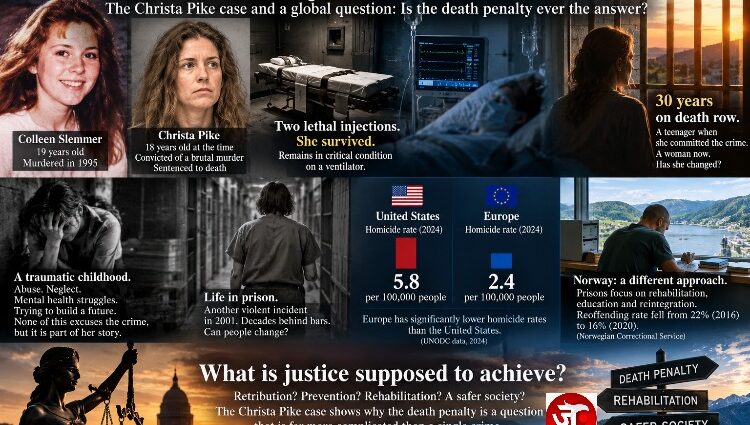
What does justice mean when a woman sentenced to death survives not one, but two lethal injections?
October 3, 2026: What does punishment mean when the state has already taken away 30 years of a prisoner’s life, yet still insists that justice requires her death? Here is a death machinery designed to produce a controlled killing instead leaves the condemned prisoner critically ill, unconscious and dependent on a ventilator?
The case of Christa Pike, Tennessee’s only woman on death row, has suddenly turned an old argument about the death penalty into something much more unsettling. Pike was convicted of one of the most brutal murders imaginable. There is no honest way to sanitize that crime, and doing so would be an insult to the memory of her victim, 19-year-old Colleen Slemmer.
But there is also no honest way to tell Pike’s story without asking what happened to the young woman who committed that crime, what happened during the three decades she spent behind bars, and whether a human being can change enough that society no longer needs to kill her.
On September 30, Tennessee attempted to execute Pike, strangely, she survived. She had been given two doses of pentobarbital, yet continued breathing for nearly an hour. Witnesses reported that she complained of pain in her arm and remained alive after the injections. She was eventually taken to hospital, where her lawyers say she remains critically ill and on a ventilator. Tennessee Governor Bill Lee has halted scheduled executions for the remainder of 2026 and ordered an independent review. The state now has to investigate how its execution system failed.But perhaps the larger question is one no technical investigation can answer: What if the death penalty itself is the part of the system that deserves examination?
What did Christa Pike do?
On January 12, 1995, Christa Pike, then 18 years old, killed 19-year-old Colleen Slemmer, another student at the Knoxville Job Corps Center in Tennessee. According to the Tennessee Supreme Court’s account, Pike had told a friend the previous day that she intended to kill Slemmer because she “just felt mean that day.” Pike, her boyfriend Tadaryl Shipp, and another young woman, Shadolla Peterson, took Slemmer to an isolated area near the University of Tennessee agricultural campus.
The attack was extraordinarily violent. Court records say Slemmer was: beaten and tortured; cut across the throat multiple times; struck in the back with a meat cleaver; and ultimately killed by a blow to the head with a piece of asphalt.
A pentagram was also carved into Slemmer’s chest. The case attracted enormous attention because of the Satanic imagery associated with Pike and Shipp. Later court records indicate that Shipp acknowledged carving the pentagram, rather than Pike. Pike subsequently gave investigators a detailed confession, and a jury convicted her of first-degree murder and sentenced her to death. The Tennessee Supreme Court upheld the conviction and death sentence in 1998. Pike was the only one of the three charged with a capital offense. Her boyfriend, Tadaryl Shipp, was 17 at the time of the murder and therefore was not eligible for the death penalty. He received a life sentence and is now eligible for parole.
Shadolla Peterson, who was 18, testified against Pike and Shipp and received probation. So one victim died. Three teenagers participated in the crime. One received a death sentence, one received life imprisonment and one received probation.
Who was Christa Pike before the murder?
This is where the story becomes much more complicated. Pike’s lawyers have spent decades arguing that her life before the murder was marked by extreme abuse, neglect, poverty and trauma. Court records and later clemency filings describe repeated sexual abuse during childhood, including allegations of rape beginning when she was very young. One documented assault occurred when she was 11, after which she told her mother but was not believed. She was also raped by a stranger at 17.
Her childhood was reportedly chaotic and violent. Court records describe severe neglect, exposure to violence, substance abuse beginning during adolescence and repeated suicide attempts. Psychological experts who examined her later identified serious mental-health problems and described the effects of her traumatic upbringing.
She also had significant educational and developmental difficulties. She failed third grade, was sent to a juvenile evaluation centre as a teenager and eventually obtained a GED. She entered the Job Corps program hoping to become a nurse. There is also evidence that her relationship with Shipp was highly dysfunctional. Later legal filings describe him as violent toward Pike while also being someone she desperately sought affection and protection from.
What did the jury hear about all this?
This is one of the most important parts of the death-penalty debate surrounding her case. Pike’s original trial established her guilt, but her later lawyers argued that the jury did not receive the full picture of her childhood abuse, mental illness and trauma when deciding whether she should live or die. Defense experts at trial did present some evidence about her psychological condition. One expert believed she had “lost control,” while another discussed how group dynamics could contribute to collective aggression among young people.
But subsequent lawyers argued that the mitigation case was badly underdeveloped. They say the jury was not adequately presented with the full history of sexual abuse, neglect, trauma and mental illness that later became central to her appeals and clemency petition.
Pike has now spent approximately three decades in prison. During that period she was also convicted in 2001 of attempted first-degree murder for an attack on another prisoner.
Why this makes the failed execution even more significant
Now bring that history together with what happened this week. Tennessee attempted to execute Pike in 2026, nearly 31 years after Slemmer’s murder. Two doses of pentobarbital were administered, but Pike survived. Witnesses reported that she remained conscious, complained of pain in her arm and continued breathing. She was ultimately transported to hospital and placed on a ventilator.
Three young people, three very different punishments
There is another extraordinary feature of the case: Three teenagers were involved. Pike was 18. Shipp, her boyfriend, was 17 and therefore was not eligible for the death penalty. He received a life sentence and is now eligible for parole. Peterson was also 18. She testified against Pike and Shipp and received probation.
That disparity does not answer the question of what sentence Pike deserved. But it forces us to confront how heavily the death penalty depends upon distinctions involving age, individual responsibility, cooperation with prosecutors and the circumstances presented to a jury.
Pike’s lawyers have spent years arguing that she came from a childhood marked by severe abuse, neglect, poverty and trauma.
Understanding is not exoneration. Trauma does not erase responsibility, nor abuse not make a victim incapable of becoming an offender. But if the justice system is going to decide who lives and who dies, shouldn’t everything relevant about the person be placed on the scales and that is precisely where Pike’s later legal arguments became significant.
Did the jury see the whole person?
Pike’s conviction has survived repeated legal challenges. The courts have upheld her guilt and death sentence. But her lawyers later argued that the original sentencing process did not fully present the extent of her childhood abuse, trauma and psychological problems to the jury deciding whether she should live or die.
The Pike execution did not occur in isolation. In May, Tennessee abandoned its attempt to execute Tony Carruthers after officials could not establish the required intravenous access. He was later granted a one-year reprieve. Pike’s case therefore raises questions about more than one difficult night inside one execution chamber raising the reliability of the system itself.
It complicates any easy argument that she entered prison as a troubled teenager and emerged decades later as an entirely transformed person.
But it also raises another question:
What is the purpose of imprisonment if a person can never be allowed to demonstrate change?
If someone commits a terrible crime at 18 and spends 30 years incarcerated, is the purpose of punishment simply to wait for the state to kill them? Or is there room for the possibility that people can change?
The justice system routinely distinguishes between the person who committed a crime and the person that individual becomes years later.
The death penalty makes that distinction almost impossible to accommodate. What if rehabilitation is possible? This is perhaps the most important question raised by Pike’s three decades behind bars. While some dedicate themselves to education, religion, art, mentoring or helping other prisoners, some never change at all. The point is that the death penalty removes the possibility of finding out.
Life imprisonment can protect society while leaving room for evidence of transformation, while execution cannot.
But what about Colleen Slemmer?
Colleen Slemmer was 19, she had a family, future, and was ultimately subject to a horrifying killing. Her mother reportedly witnessed the failed execution and described the experience as denying her daughter justice. Any discussion of rehabilitation that ignores Slemmer risks becoming morally lopsided.
But acknowledging Slemmer’s suffering does not automatically settle the question of whether Pike must die. There is a distinction between remembering the victim and requiring another death. Justice for a victim and execution of an offender are not necessarily synonymous.
For decades, the debate has often been framed like this: Does a murderer deserve to die? Perhaps the better question is: What does society need justice to accomplish? If the answer is protecting the public, imprisonment can accomplish that. If the answer is accountability, a life sentence can impose extraordinary punishment. If the answer is rehabilitation, imprisonment can potentially leave room for change. If the answer is retribution, the death penalty provides the ultimate expression of it.
But there is one thing execution cannot provide: the possibility that the person who committed the crime may become something different from the person who committed it.
And there is another thing execution cannot tolerate: mistake.
Two injections changed the argument
Christa Pike was supposed to become the first woman executed by Tennessee in more than two centuries. Instead, she became something else entirely: the woman who survived the state’s attempt to kill her after receiving two doses of lethal injection drugs. She is now unconscious and on a ventilator, while the governor has paused executions, the state is investigating, her lawyers are seeking answers, the victim’s family is still living with the consequences of a murder committed more than three decades ago, and And America is left staring at the same old question from a different angle.
What is justice supposed to achieve?
If society can protect itself without killing, and if human beings can change, why should death be the one punishment from which there is no possibility of correction, rehabilitation or redemption?
The European Union has repeatedly encouraged member states to make rehabilitation and social reintegration central to imprisonment because reducing reoffending is ultimately a form of public protection. Research reviewed by the European Parliament points to education, employment, treatment, social connections and reintegration support as factors that can influence whether someone returns to crime.
Norway goes further: Its Correctional Service describes its mission not merely as imprisoning offenders but as preventing recidivism by helping them change their criminal behaviour. Under Norway’s “principle of normality”, the punishment is the loss of liberty. Other rights are not automatically stripped away simply because someone is imprisoned.
That philosophy does not mean Norway believes criminals should escape punishment. It means punishment has an objective beyond suffering. The prisoner is removed from society because society must be protected. But the prisoner is also given the opportunity to become someone who can eventually return to society without posing the same threat.
The Norwegian experience offers at least one reason to take rehabilitation seriously. Official Nordic correctional statistics recorded Norway’s two-year reconviction rate falling from 22% among people released in 2016 to 16% among those released in 2020. The figures require caution because the pandemic disrupted crime reporting and justice processes, but they nevertheless illustrate the kind of outcome rehabilitation-oriented systems are designed to pursue.
The larger lesson is not that Europe has discovered a magical formula that eliminated crime. It has not. The lesson is simpler. A society can punish without deciding that a human being is permanently beyond change.
And that may be the most important difference between punishment and rehabilitation.
One closes the door forever. The other leaves open the possibility that a human being can become more than the worst thing they have ever done.
JANPATH NEWS NETWORK (JNN)
Independent. Fearless. On the People’s Path.