The controversy over India’s electoral rolls is no longer a West Bengal story, but is a national story.
October 3, 2026: The Special Intensive Revision, or SIR, being conducted by the Election Commission has affected voter rolls across states and Union Territories, with more than 13 crore names left out of draft electoral rolls across 30 States and UTs, according to data compiled from the states where the exercise has progressed. These names are not automatically permanent deletions, and eligible voters have opportunities to seek inclusion. But the scale of the exercise has triggered a fundamental democratic question:
How many eligible Indians risk being left out of the electoral process, and how easily can they get back in?
The TMC subsequently argued before the Supreme Court that SIR deletions affected the election result in 31 constituencies, where the number of deleted voters exceeded the winning margin. The Supreme Court allowed the party to bring a fresh application on that issue. The Election Commission disputes the claim.
The Election Commission began the nationwide SIR process with Bihar and subsequently expanded it across much of the country. In May, the Commission announced the third phase covering 16 states and three Union Territories, involving more than 36.7 crore electors and nearly 4 lakh Booth Level Officers. The stated objective was to comprehensively revise the electoral rolls.
The exercise has now reached a point where the Commission itself has ordered a special drive in 20 States and Union Territories where SIR has been completed, specifically to identify eligible voters who may have been left out and facilitate their enrolment. That instruction includes young voters, first-time voters and people whose names were left out during or after SIR.
The Commission has directed state election officials to compare pre- and post-SIR rolls and conduct outreach to voters who may have been missed.
This development means the question is no longer simply being raised by opposition parties, activists or protesters.
From Bengal to Maharashtra, Delhi, Kerala and beyond
The numbers vary dramatically from state to state. In Maharashtra, the SIR process has involved millions of voters, with more than 1.2 crore voters reportedly required to respond to notices and submit documents in the ongoing exercise. The state has been given additional time to process claims and objections.
In Delhi, the draft electoral roll saw the electorate fall by roughly 32.8 per cent, according to figures released after the SIR exercise. Maharashtra’s draft roll showed a reduction of about 21.1 per cent.
In Kerala, the final roll published after SIR contained 8.57 lakh fewer names than the earlier electoral roll.
In Gujarat, the electorate fell substantially during the second phase, with the reduction reported at about 13.4 per cent, while Kerala recorded the lowest reduction among the nine states and UTs covered in that phase.
And in Karnataka, fresh controversy has emerged over allegations that Form 7 applications were being used in bulk to seek deletion of eligible voters. Indian Express reported that 279 such applications were filed across 16 polling stations in one constituency, including 82 applications targeting Muslim voters in Ujire. These allegations are under investigation and should not be treated as established wrongdoing without due process.
The Election Commission says voters may be removed for legitimate reasons, including death, duplication, migration or being untraceable. The Commission also says its SIR process is lawful and has been approved by the Supreme Court.
The point is something more basic: When millions of names disappear from electoral rolls, the burden of proving that every eligible voter can recover their right to vote becomes enormous.
What happened in West Bengal could be a warning for the country
This is why the Bengal numbers matter nationally. The Election Commission told the Supreme Court that more than 22 lakh excluded voters in West Bengal had filed appeals seeking restoration. Overall, around 38 lakh appeals were filed before the appellate tribunals, with approximately 37 lakh still pending according to the Commission’s recent submission.
If millions of voters are excluded during a revision exercise, can the appeals system process their cases quickly enough before they need to vote?
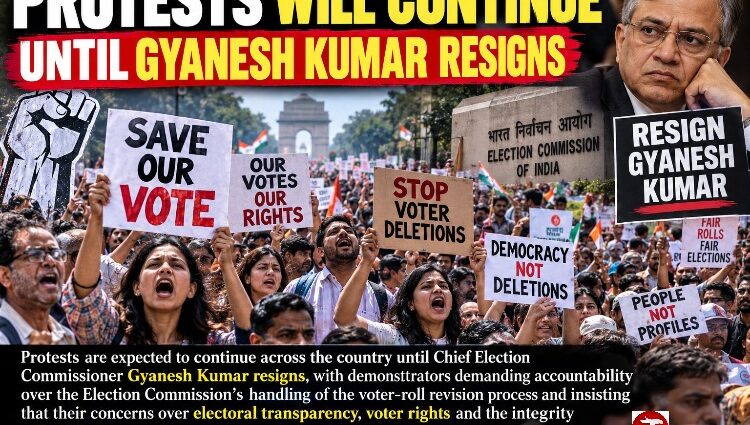
That is why the October 2 protest in Delhi cannot be viewed only as another opposition demonstration. The protesters were challenging the Election Commission’s handling of voter verification and the SIR process. The march was stopped before it could reach Jantar Mantar.
Delhi Police had imposed restrictions on public gatherings in the area and said the demonstration had not been authorised. Large numbers of protesters were detained as police prevented groups from reaching the protest site.
The exact number reported by different outlets varied, with Hindustan Times reporting around 1,000 detentions. The controversy has increasingly focused on Chief Election Commissioner Gyanesh Kumar. Opposition parties and activists, and civilians joining in have demanded his resignation and accused the Commission of failing to protect electoral integrity.
Reuters reported that the Commission has also faced scrutiny over the scale of voter exclusions, internal disagreements and the procedures used to verify voters. The Commission has defended its process and announced procedural changes, including greater assistance to voters and home visits in some circumstances.
The real issue is the institutional credibility of the Election Commission of India. The Jantar Mantar protest was ultimately about much more than one demonstration. It brought together a growing national anxiety over who appears on India’s electoral rolls and who does not. Due to the rising anger and to appease the people, the the Election Commission has now ordered special drives to find and enrol eligible voters across 20 States and Union Territories, who may have been left out.
But, the protests will be going on until Gyanesh Kumar resigns.
JANPATH NEWS NETWORK (JNN)
Independent. Fearless. On the People’s Path.