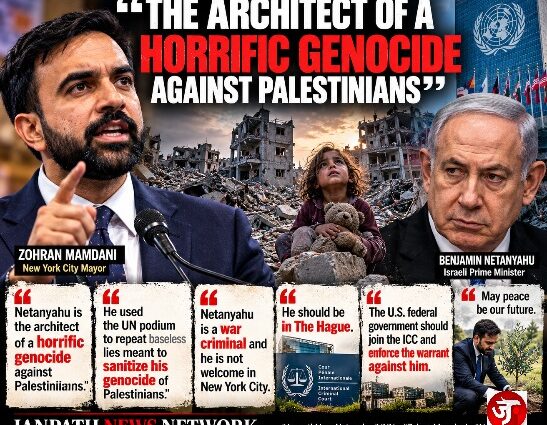
New York City Mayor Zohran Mamdani has delivered one of the most direct political condemnations of Benjamin Netanyahu, calling the Israeli prime minister “the architect of a horrific genocide against Palestinians.”
The words are uncompromising. Mamdani also accused Netanyahu of using the United Nations podium to repeat what he described as “baseless lies meant to sanitize his genocide of Palestinians.”
His statement comes against the backdrop of the devastation in Gaza, where years of conflict have left vast areas destroyed, hundreds of thousands displaced and civilians living amid the ruins of homes, neighbourhoods and essential infrastructure.
For Mamdani, the destruction cannot simply be discussed in the detached language of diplomacy. He is calling it genocide, words that carry enormous weight.
It is a word that describes, in Mamdani’s view, not merely the consequences of war but the destruction inflicted upon Palestinians on a scale that he believes demands the strongest possible moral condemnation.
In July 2026, Mamdani said that he had reviewed whether New York City could enforce the ICC warrant against Netanyahu and concluded that the city did not have independent legal authority to do so. He then called on the U.S. federal government to join the ICC and enforce the warrant. He also said Netanyahu was “not welcome in New York City” and that he believed the Israeli prime minister belonged in The Hague.
Most importantly, Mamdani explicitly called Netanyahu “a war criminal” and “the architect of a horrific genocide against the Palestinian people.” He also pointed to the killing of an 11-year-old Palestinian boy in what was described as a safe zone in Gaza when explaining his condemnation.
Then, after Netanyahu’s September 24 UN speech, Mamdani responded directly. He said Netanyahu had used the UN podium to “repeat baseless lies meant to sanitize his genocide of Palestinians”, adding that no such statement could change the fact that Netanyahu remains subject to an ICC arrest warrant alleging war crimes and crimes against humanity.
There was also a striking symbolic gesture on the same day. Mamdani planted an olive tree at Gracie Mansion with Palestinian families from Gaza, captioning the post, “May peace be our future.”
Netanyahu has fiercely rejected the accusation, calling the charge “the greatest lie of the century.” He has argued that Israel’s military campaign is directed against Hamas following the October 7, 2023 attack, which killed approximately 1,200 people in Israel and resulted in around 250 people being taken hostage.
But Mamdani’s accusation forces attention back to the reality Palestinians have experienced throughout the war. The images from Gaza are difficult to absorb: shattered buildings, streets transformed into rubble, families searching for shelter, children surrounded by destruction and communities struggling to rebuild lives that have been repeatedly torn apart.
Mamdani’s words are therefore not simply another exchange between two politicians, but represent a profound moral confrontation over how the destruction of Gaza should be understood.
The legal question remains separate. The International Criminal Court’s warrants concerning Netanyahu and former Defence Minister Yoav Gallant allege war crimes and crimes against humanity, rather than genocide. The International Court of Justice has issued provisional measures in South Africa’s case against Israel but has not delivered a final judgment determining that genocide has occurred.
Yet Mamdani has chosen a word far stronger than the legal findings currently established against Netanyahu. Genocide. His choice of that word reflects his belief that the scale and nature of Palestinian suffering cannot be sanitised through diplomatic language.
His position has also been reinforced by his public engagement with Palestinian families from Gaza, including hosting families at Gracie Mansion and planting an olive tree with them, a powerful symbol of Palestinian connection to land, memory and survival.
Netanyahu sees the conflict through the lens of Israel’s security and the October 7 attack.
Mamdani sees Gaza through the devastation suffered by Palestinians.
Between those two narratives lies a landscape of ruins that the world has watched unfold in real time.
Whatever the eventual legal judgment, Mamdani’s accusation has placed an unmistakable question at the centre of the international conversation:
When an entire population is confronted with mass death, displacement and destruction, how long can the world continue to describe what it sees in language that feels detached from the human reality?
JANPATH NEWS NETWORK (JNN)
Independent. Fearless. On the People’s Path.