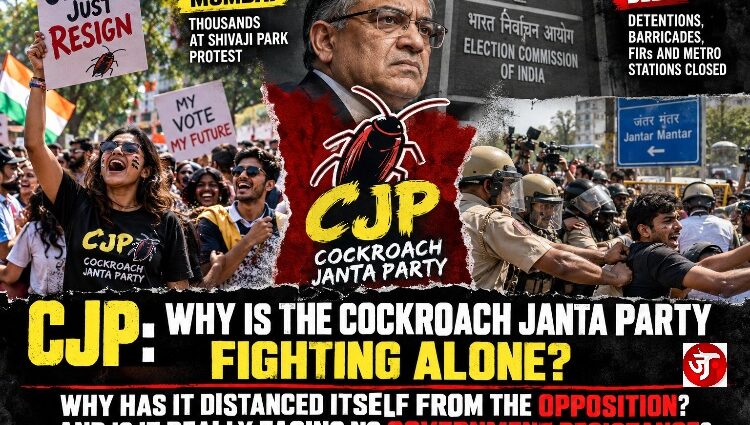
CJP, the Cockroach Janta Party, has emerged as one of the most unusual political movements in the growing campaign against Chief Election Commissioner Gyanesh Kumar. But as CJP protests continue across India, an important question is increasingly being asked:
Why has CJP distanced itself from the opposition, and is it really facing no government resistance?
The answer is more complicated than either side would like. CJP has deliberately maintained its distance from established opposition parties. It began as a youth-led, satirical movement rather than a conventional political party. Its appeal is partly that it does not look like Congress, AAP, CPI(M) or another established political organisation. That gives it a different political identity and makes it harder to dismiss as simply another opposition campaign.
Reuters describes it as an unexpected youth political force that has emerged from online frustration. They have distanced themselves perhaps to prove to themselves they could do it alone without any political party taking credit for its success. CJP has deliberately positioned itself outside the conventional opposition structure.
It began as a youth-led, satirical movement rather than a conventional political party. Its appeal is partly that it does not look like Congress, AAP, CPI(M) or another established political organisation. That gives it a different political identity and makes it harder to dismiss as simply another opposition campaign. Reuters describes it as an unexpected youth political force that has emerged from online frustration. It wants to keep that image.
That matters politically. A government can portray a conventional opposition rally as partisan. It is considerably harder to explain away thousands of young people turning up with humour. chocolate wrapper jewellry, national flags and a demand centered on their right to vote.
Then, as to to the questions running around that the government favours them, there is a record of recent CJP protests shows that the organisation has faced police restrictions, detentions, barricading and FIRs.
Then, there are competing accusations about who CJP actually represents. The political accusations have come from both sides:
Congress has expressed suspicion that CJP could ultimately benefit the BJP splitting or diverting opposition votes, and has questioned its funding, organisational structure and political independence. There is no public evidence establishing that CJP is BJP/RSS-controlled.
The BJP has accused CJP of being an AAP proxy, particularly after AAP leaders publicly connected themselves with the student agitation.
Maharashtra CM Devendra Fadnavis has called CJP “Congress Jitao Party”, alleging that Congress is using the organisation to fill a political vacuum. CJP rejects that accusation.
There has even been an internal split. Former CJP leader Manish Brahmbhatt launched CJP-Democratic and accused Dipke’s faction of becoming “Team Kejriwal.”
Dipke’s response has essentially been: decide first which party you are accusing us of belonging to. He has rejected both the Congress-B-team and AAP-B-team labels, saying CJP is the “A team of the students.”
And there is a particularly interesting development right now: Congress spokesperson Reetam Singh has alleged that CJP’s Ashutosh Ranka declined to meet Congress representatives during their Assam outreach because the initiative was being treated as an AAP-led effort.
CJP protests: very different responses in Delhi and Mumbai
On October 2 and 3, the protest in Delhi faced a substantial police response. Hundreds of protesters were detained as they attempted to reach Jantar Mantar. Police blocked access to the protest site, enforced restrictions on assemblies, closed nearby Metro stations and registered FIRs. On October 3, police again detained protesters after some broke through barricades.
The Mumbai CJP protest unfolded differently. CJP’s Shivaji Park demonstration reportedly attracted thousands of people. Police had denied permission for the gathering, yet the protest went ahead under heavy police deployment without the kind of mass detention seen in Delhi.
But does CJP face no government resistance?
No. That claim would be demonstrably wrong. The recent evidence is actually quite striking. CJP has faced police restrictions, denied permissions, detentions, FIRs and, during its earlier NEET agitation, serious clashes with security forces. The heavier Delhi crackdown was directed at a broader coalition of Congress supporters, CJP supporters, student groups and opposition leaders.
There are the strongest documented examples:
- Mumbai Police denied permission for the October 2 protest.
CJP said Mumbai Police refused permission for its planned Gandhi Jayanti demonstration against CEC Gyanesh Kumar. Founder Abhijeet Dipke responded by announcing a possible “Jail Bharo Andolan.” - CJP went ahead despite the denial, and an FIR followed.
The October 2 Shivaji Park gathering proceeded despite the lack of permission. Mumbai Police subsequently registered an FIR against CJP leaders, including Abhijeet Dipke, Pranav Ahire, Ashutosh Ranka and others, along with more than 400 unidentified supporters, alleging an unauthorised gathering. - The Mumbai protest itself was legally contentious.
Reports say the gathering occurred despite police denial and a court order concerning gatherings at Shivaji Park. That means CJP was not simply operating with official approval. - CJP faced serious police allegations during its earlier July mobilisation.
After the July Parliament march, Delhi Police registered multiple FIRs relating to clashes. Police later registered another FIR alleging that RAF personnel were assaulted during the unrest. The police said around 70 protesters were detained during the July clashes. - A CJP-associated activist was detained in connection with an assault allegation.
In September, activist Swatantra Bhardwaj was detained in Uttar Pradesh after Delhi Police accused him of assaulting the father of a student during a June CJP protest. Additional provisions, including the SC/ST Act, were subsequently added to the case. These are allegations and should be described as such. - The resistance faced by CJP has not been confined to its protests against Gyanesh Kumar in Delhi and Mumbai. The organisation’s “School Thik Karo” campaign has also triggered confrontations, restrictions and police cases in several states.
- In Rajasthan, the government moved to restrict CJP’s access to government schools shortly after the organisation announced plans to inspect schools across the state. Outsiders were barred from entering government schools without prior permission, while photography, videography, interviews and live-streaming were also restricted. The timing of the order, issued as CJP prepared to conduct school inspections, immediately became a political controversy.
- The confrontation escalated in Jaipur’s Rampura Kanwarpura village. A CJP team attempting to inspect a government school was confronted by local residents. CJP alleged that its workers were attacked, stones were thrown, vehicle windows were smashed and members of the team were assaulted. Police, however, described the incident as a tussle between villagers and CJP workers and said they had not received complaints of anyone being beaten. The BJP denied involvement in the alleged attack.
- Maharashtra also moved against CJP’s school campaign. The Mumbai civic education department barred CJP volunteers from entering municipal schools without permission. In Latur, CJP founder Abhijeet Dipke and other CJP workers were subsequently booked after a teacher complained that they had entered a Zilla Parishad Urdu school without permission, questioned students and filmed inside the premises. The FIR accused them of disrupting official work and threatening teachers. These are allegations contained in the complaint, not convictions.
- Then came an even more disturbing incident in West Bengal. According to CJP and the family of CJP volunteer Shaik Abdul Hafeez, local BJP workers allegedly went to Hafeez’s home after he raised concerns about a government primary school as part of the School Thik Karo campaign. Hafeez and his father, Sk Muhammad Mafik, were allegedly assaulted. Mafik later died at Burdwan Medical College and Hospital. Three people were arrested in connection with the incident, according to reports citing BJP leader Suvendu Adhikari. The allegation that the assailants were BJP workers remains an allegation and should be attributed as such.
Taken together, these incidents complicate any claim that CJP has been allowed to operate without resistance. There is evidence of government restrictions, denied access, police cases and FIRs, as well as confrontations involving people whom CJP alleges are politically connected to the BJP.
CJP is being challenged through permission denials, barricading, detention, FIRs and police action, but the movement has nevertheless managed to keep returning to the streets and attract increasingly large crowds.
And there is an especially interesting contradiction here.
Mumbai: permission denied, but the CJP protests anyway, with FIR against organisers and hundreds of supporters. They were still on the streets.
Delhi: permission denied, but Opposition and student activist, protesters attempt to reach Jantar Mantar is clubbed with mass detentions and FIRs.
CJP has announced another mobilisation at Jantar Mantar for October 10 if Gyanesh Kumar does not resign.
There is an interesting historical wrinkle here. During CJP’s earlier campaign against Education Minister Dharmendra Pradhan, it largely avoided attacking the BJP itself. Now, with Gyanesh Kumar as its target, it is directly confronting an institution and an issue that the opposition is also attacking. The Week describes this as a significant shift in CJP’s trajectory.
The answer may ultimately determine whether CJP remains a short-lived youth protest movement or develops into a significant new force in India’s political landscape.
For now, one thing is clear: CJP is no longer easy to ignore.
JANPATH NEWS NETWORK (JNN)
Independent. Fearless. On the People’s Path.