









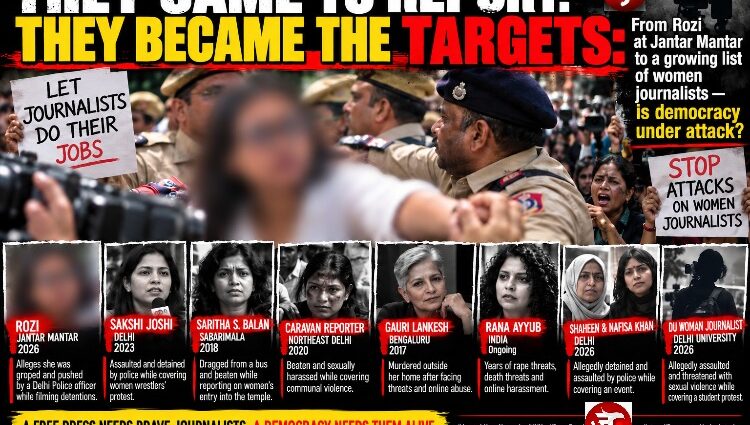
A disturbing question is once again confronting India’s media: What happens when the woman holding the camera becomes the target?
October 5, 2026: The question has acquired fresh urgency after the October 3 confrontation at Jantar Mantar, where three women journalists alleged that they were manhandled and sexually harassed by Delhi Police personnel while covering protests demanding the resignation of Chief Election Commissioner Gyanesh Kumar over controversies surrounding electoral-roll revisions.
Among those detained during the protests was AISA president Neha Bora. As police moved against protesters and activists, journalists attempting to document the detentions found themselves caught in the confrontation.
An independent journalist alleged that ACP Vivek Bhagat groped her and pushed her while she was filming the detention of Bora. The allegation is serious and remains subject to investigation. Delhi Police has transferred complaints from three women journalists to the Crime Branch for inquiry.
The confrontation did not end at Jantar Mantar. At Parliament Street Police Station, journalists staged a sit-in demanding action and an FIR. A video circulated by News24 appears to show a heated confrontation in which a police officer allegedly twists a woman journalist’s wrist and shouts: “तू बेशर्म, तेरी मां बेशर्म.”
The police and the journalists have sharply different accounts of what happened. Delhi Police has said it is examining CCTV footage and other evidence, while authorities have also questioned the authenticity of some material circulating online. The Crime Branch has now been tasked with investigating the complaints.
But the Jantar Mantar episode does not exist in isolation. It comes amid a succession of disturbing allegations and attacks involving women journalists across India.
When the reporter becomes the target
In February 2026, the National Human Rights Commission took suo motu cognisance of the reported physical and sexual assault of a woman journalist covering a student protest at Delhi University’s North Campus. According to the complaint cited by the NHRC, the journalist was allegedly targeted after protesters identified her caste, assaulted her and threatened to parade her naked. The NHRC sought a report from the Delhi Police Commissioner.
Just weeks before the Jantar Mantar confrontation, in September 2026, journalists Shaheen Khan and Nafisa Khan alleged that they were detained and assaulted by Delhi Police personnel after attempting to cover an event in Delhi. They alleged that police questioned them about their religion before the alleged assault. Delhi Police denied the allegations and described them as factually incorrect and misleading.
The pattern stretches further back. In 2023, journalist Sakshi Joshi was assaulted and detained by Delhi Police while covering the women’s wrestlers’ protest. Reports said she was grabbed, pushed and had her phone taken as she attempted to document the police action.
In 2020, a woman reporter from The Caravan was among journalists attacked while covering communal violence in northeast Delhi. She reported being subjected not only to physical violence but also sexual harassment and threats.
And in 2017, the country witnessed the most horrifying possible reminder of the dangers journalists can face. Gauri Lankesh, journalist and editor, was shot dead outside her Bengaluru home. Her killing became a symbol of the deadly consequences that can follow sustained intimidation and hatred against journalists.
Investigative journalist Rana Ayyub, meanwhile, has faced years of rape threats, death threats, doxxing and sexually abusive online campaigns. Such attacks demonstrate another dimension of the danger confronting women journalists: the attempt to destroy a woman’s professional voice by attacking her body, sexuality, reputation and personal identity.
A camera should not become a crime
The disturbing feature common to many of these episodes is not simply that journalists were present at protests. They were doing their jobs, asking questions, filming arrests, documenting demonstrations, and reporting what they saw. And yet again and again, the journalist appears to become part of the confrontation.
For women journalists, the intimidation can take an especially ugly form. Physical force can be accompanied by sexualised abuse, threats of rape, attacks on character, religious or caste-based slurs, online harassment and attempts to expose private information.
The message is chillingly effective: stop filming, stop asking questions, stop reporting.
Jantar Mantar is bigger than one incident
The allegations surrounding October 3 must ultimately be established through a credible and impartial investigation. The Press Club of India and other journalist organisations have demanded accountability. The continuing controversy has also drawn political condemnation and renewed attention to the safety of journalists covering protests.
The real issue, therefore, is bigger than ACP Vivek Bhagat, larger than the recent female journalist’s attack, louder than Neha Bora and goes far beyond one afternoon at Jantar Mantar. A democracy needs protesters, the police, but a democracy also needs journalists who can stand between the two and record what is happening.
When the journalist is attacked for holding the camera, the danger is not confined to one woman. The camera itself becomes the target. And when women journalists repeatedly report being beaten, sexually harassed, threatened or silenced, India must ask a deeply uncomfortable question: Is democracy being crushed in the world’s largest democracy?
JANPATH NEWS NETWORK (JNN)
Independent. Fearless. On the People’s Path.