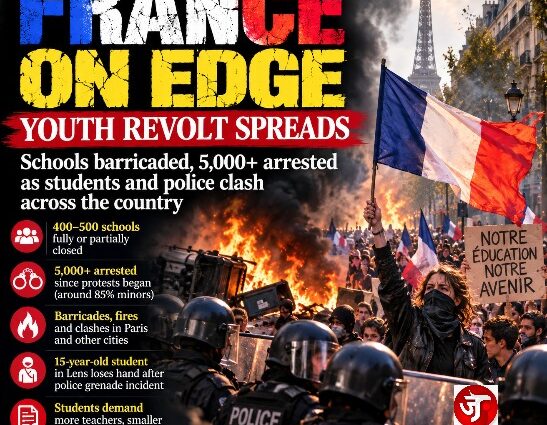
Schools barricaded, 5,000+ arrested as students and police clash across the country: France is facing one of its most serious youth protest movements in decades, with high-school students blockading schools, unions joining demonstrations and clashes with police spreading across the country.
October 6, 2026: The protests began in late September in the Paris suburbs over chronic problems in the education system, including teacher shortages, overcrowded classrooms, inadequate school buildings and long-standing difficulties replacing absent teachers. Within days, the movement spread to cities across France.
By October 5, roughly 400 to 500 high schools were reported to be fully or partially closed. Students erected barricades using rubbish bins, bicycles and other objects, while demonstrations took place in Paris, Lille, Marseille, Nantes and other cities. Trade unions representing teachers and school staff have now joined the mobilization.
The confrontation has become increasingly violent. French authorities say more than 5,000 people have been arrested since the protests began, with about 85% reportedly minors. Amnesty International has condemned what it describes as disproportionate police tactics, citing the use of tear gas, batons and crowd-control weapons against young demonstrators.
One incident has become a grim symbol of the escalating confrontation. A 15-year-old student in Lens lost his hand after an explosive police dispersal device detonated while he was handling it. An investigation into the circumstances has been opened.
There have also been reports of injuries among students and teachers, while dozens of schools have suffered vandalism or fire damage.
The anger is rooted largely in the condition of France’s public education system.
Students are demanding more teachers, reliable replacements for absent staff, smaller classes, better-maintained school buildings and changes to demanding school schedules. Many say they are being asked to prepare for their futures inside overcrowded and deteriorating institutions.
Prime Minister Sébastien Lecornu has acknowledged that the students’ concerns are legitimate and instructed ministers to develop proposals addressing their demands by the end of October, while insisting that violence must be confronted.
The images of burning barricades, riot police and thousands of angry young people make for dramatic television and social media. But calling this a civil war would be misleading.
France remains under civilian government control, and the unrest is principally a nationwide protest movement centred on education, social conditions and government policy, accompanied by episodes of serious violence and confrontations with police.
The real danger is that the confrontation continues to escalate. With unions now backing the students and demonstrations spreading, France faces a difficult test: whether authorities can restore order without turning an education crisis into a much deeper political and social confrontation.
JANPATH NEWS NETWORK (JNN)
Independent. Fearless. On the People’s Path.