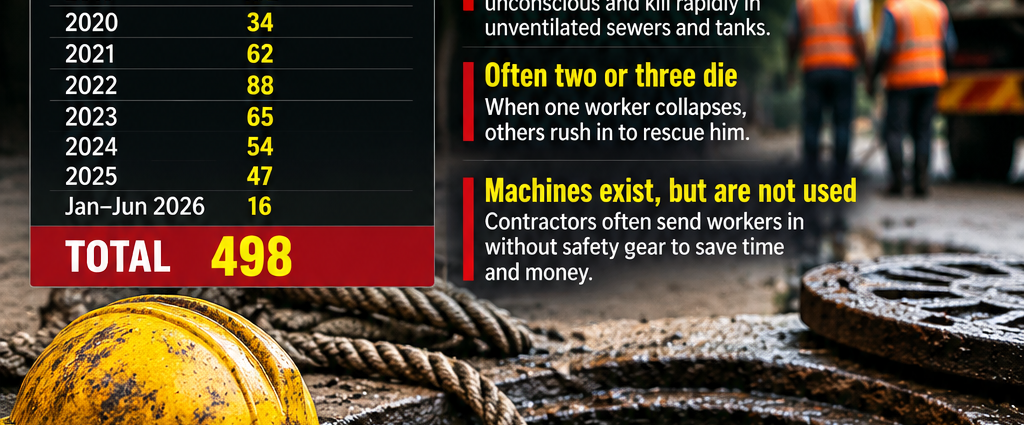
498 sanitation workers died while cleaning sewers and septic tanks between January 1, 2019, and June 30, 2026. Yet the government has simultaneously maintained that no death has been reported due to “manual scavenging.”
October 6, 2026: India says manual scavenging has been eradicated. Yet hundreds of sanitation workers have died inside the country’s sewers and septic tanks, inhaling poisonous gases, suffocating in confined spaces and collapsing while doing work that the law itself says must not be performed without safety measures.
The contradiction is stark! Government data placed before Parliament shows that 498 sanitation workers died while cleaning sewers and septic tanks between January 1, 2019, and June 30, 2026. Yet the government has simultaneously maintained that no death has been reported due to “manual scavenging.”
So where did the deaths go?
Under India’s 2013 law, “manual scavenging” refers specifically to the prohibited handling of human excreta from insanitary latrines. Sewer and septic-tank entry without prescribed safety measures is treated separately as hazardous cleaning. The distinction may be legal, but for the families of workers who never came home, the difference is painfully meaningless.
498 dead. But officially, zero manual-scavenging deaths.
The government’s own figures tell a grim story.
| Year | Reported deaths |
|---|---|
| 2019 | 132 |
| 2020 | 34 |
| 2021 | 62 |
| 2022 | 88 |
| 2023 | 65 |
| 2024 | 54 |
| 2025 | 47 |
| Jan–Jun 2026 | 16 |
| Total | 498 |
The government has separately reported 332 sanitation-worker deaths in 18 states and Union Territories between January 2021 and June 2026, attributing them to hazardous sewer and septic-tank cleaning. It also reported 193 FIRs in the previous five years against agencies and officials for hazardous manual cleaning.
The numbers themselves expose the scale of the problem. The terminology exposes something else. A sewer or septic tank is not simply a dirty workplace. It can be a death chamber.
Decomposing sewage can produce toxic and flammable gases, including hydrogen sulfide and methane. In an enclosed, poorly ventilated space, a worker can become unconscious and die rapidly. And when one worker collapses, others frequently rush in to rescue him, turning one death into two or three.
The equipment that could prevent such tragedies exists: suction machines, jetting equipment, robotic systems, protective harnesses, breathing equipment and other mechanised technologies.
The problem is that machines do not always reach the narrowest drains, municipal systems remain unevenly mechanised, and contractors can have a powerful incentive to save time and money.
The result is a horrifying equation: a blocked drain, a rope, a human body and poisonous gas.
Is it a caste burden buried underground?
The workers performing this most dangerous sanitation work are overwhelmingly drawn from historically marginalised communities, particularly Dalit sanitation-worker communities.
Many are employed through contractors rather than directly by municipalities. When a worker dies, a family may receive compensation. But compensation after death is not a safety system. It is a receipt for a life that should never have been lost.
Activists have also challenged the government’s numbers. The Safai Karmachari Andolan has maintained a substantially higher count of sewer and septic-tank deaths, arguing that many fatalities never enter official databases because police and local authorities record them differently or fail to report them to the relevant commission. Independent tracking of SKA’s figures similarly shows higher annual counts than the official data.
This is not a case where the law is unclear.
The Supreme Court, in its 2023 judgment in Balram Singh v. Union of India, directed the Union and states to ensure that manual sewer cleaning is completely eradicated and that outsourced sewer work must not require individuals to enter sewers. It also ordered rehabilitation measures and raised compensation for sewer deaths to ₹30 lakh.
In 2026, courts continued to confront the reality that workers were still dying.
The Bombay High Court has ordered ₹30 lakh compensation in cases involving septic-tank deaths and criticised the continued existence of such practices despite constitutional protections and judicial directions.
If a worker enters a sewer without adequate protection, is overcome by poisonous gas and dies while cleaning human waste, does changing the official category make his death any less real? No.
India may be able to declare itself “manual-scavenger free” through a particular definition. But the bodies emerging from sewers and septic tanks tell a different story.
The real measure of a sanitation system is not how cleverly it classifies a dead worker, it is whether the worker was ever required to enter that sewer in the first place.
JANPATH NEWS NETWORK (JNN)
Independent. Fearless. On the People’s Path.