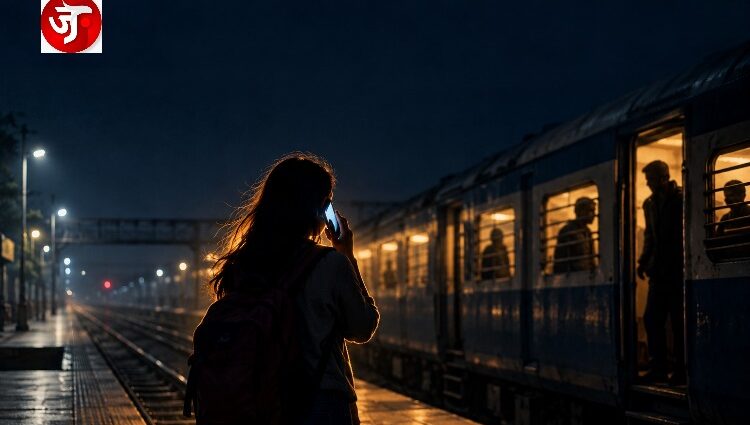
Assam student’s reported distress calls, allegations of harassment and the failure to locate her have triggered protests, political intervention and urgent questions about women’s safety on Indian trains.
October 9, 2026: A 20-year-old college student from Assam reportedly told her friends that she felt unsafe among men in a train compartment in the early hours of October 6. She shared a video of the compartment and sought help. Her family and friends say they alerted railway authorities. Yet Himashri Boro disappeared during the journey home, and her body was subsequently found beside railway tracks in Andhra Pradesh.
The tragedy has left her family demanding answers and raised a question that no railway safety campaign can afford to ignore: What happens when a woman says she is in danger aboard a moving train?
Himashri, a student at B. Borooah College in Guwahati and a dancer, had travelled to Visakhapatnam for a dance programme. She was returning to Assam ahead of a college examination scheduled for October 10. Her journey aboard the Kanyakumari–Dibrugarh Vivek Express, train number 22503, ended in circumstances that remain under investigation.
According to media reports, she boarded the Kanyakumari–Dibrugarh Vivek Express, train number 22503, at Visakhapatnam around midnight on October 5–6.
At approximately 2:39 a.m. on October 6, she reportedly contacted a friend and said that men in her coach were troubling her and that she felt unsafe. Reports also describe her sharing a video showing the compartment.
Her reported distress call is central to police investigation: One of the most serious allegations concerns the response to the reported distress call. According to the family’s account, Himashri’s friend contacted railway helpline 139 and informed authorities that she was travelling on train 22503. The family alleges that railway personnel failed to check on her after the alert.
Her family suspects foul play and has alleged negligence by railway authorities. The preliminary police assessment, however, has suggested that she may have fallen from the moving train.
According to reports based on accounts from her family and friends, Himashri contacted a friend at approximately 2:39 a.m. on October 6, expressing fear about the men around her. She reportedly shared a video showing the compartment and said she felt unsafe.
Her friend reportedly contacted railway helpline 139. The family has alleged that railway personnel failed to locate or assist Himashri despite the warning.
When the train reached Guwahati, Himashri was missing. Reports say her belongings were found in the S2 coach, while her family struggled to establish her whereabouts.
Her body was subsequently found beside railway tracks in Srikakulam district, Andhra Pradesh. The discovery transformed a missing-person search into a death investigation.
Investigators must now reconstruct her movements between boarding the train and the discovery of her body. They need to establish when she was last seen inside the train, whether she left or fell from it, and whether any person or incident contributed to her death.
Media reports have also described CCTV footage showing an unidentified man near her on the platform before she boarded. The footage, her phone records, the video she reportedly shared, statements from passengers and the post-mortem findings could all prove important.
The latest update: October 9, 2026
As of October 9, the following developments have been reported:
- Police investigation continues. The Government Railway Police (GRP) in Palasa has reportedly registered a case, with a separate case also registered by the Railway Protection Force in Srikakulam. Investigators are examining CCTV footage, call records and other evidence to reconstruct the journey.
- The cause of death remains unresolved. The preliminary railway police assessment suggests a possible fall from a moving train. Himashri’s family suspects foul play and has demanded a comprehensive inquiry. The available reporting does not establish that she was murdered or conclusively prove an accidental fall.
- The post-mortem has been completed. India Today NE reported on October 9 that the examination had been completed and that her body was expected to be brought to Assam that day. The final medical findings and their implications have not been established in the reporting reviewed for this update.
- Political intervention has been sought. Congress MP Gaurav Gogoi has urged Union Railway Minister Ashwini Vaishnaw to intervene, citing concerns over the reported harassment, the circumstances of her disappearance and passenger safety.
- Students have demanded justice. Students of B. Borooah College protested outside the institution on October 8, calling for a thorough and impartial investigation and accountability from the authorities.
What remains unknown: Whether the reported distress call triggered an effective response, what happened inside the coach after her last communication, how she came to be beside the tracks, and whether the forensic evidence supports an accident or another explanation.
Women’s safety cannot be reduced to a warning to “be careful”
Women travelling alone are routinely advised to share their locations, keep their phones charged, avoid empty compartments and call relatives frequently. Such precautions can help, but they do not transfer responsibility for harassment from the perpetrator to the woman. Some women even blame her for entering the general compartment!
A passenger should not have to depend on luck, the goodwill of strangers or the ability to reach a friend when she feels threatened. Nor should an emergency request disappear between different authorities responsible for railway security.
The Himashri Boro case demands an examination of the systems meant to protect passengers: the speed of emergency responses, coordination between the GRP and RPF, the ability of onboard staff to locate a threatened passenger and the accountability mechanisms for missed alerts.
The National Crime Records Bureau figures cited by Gaurav Gogoi have also brought renewed attention to offences registered by railway police. Such figures need careful interpretation, but they underline the importance of transparent reporting and effective prevention.
What caused this tragedy?
That is precisely what investigators must establish.
The reported harassment may be relevant to the events leading to Himashri’s disappearance. The family’s allegations raise the possibility of foul play and questions about whether authorities acted adequately. The preliminary suggestion of an accidental fall must also be tested against the physical and forensic evidence.
A responsible investigation must examine all credible possibilities without deciding the conclusion in advance. It must establish the cause of death, identify any person who may have harmed her, and determine whether a failure to respond to her reported distress contributed to the outcome.
If criminal wrongdoing or negligence is established, the appropriate action must follow.
A young woman was trying to get home
Himashri was a student returning to Assam for an examination. She was not asking for special treatment. She was undertaking an ordinary journey that millions of people make.
Her death should not become another headline that disappears after a few days of public outrage. Her family deserves answers, and women travelling on Indian Railways deserve systems that respond when they ask for help.
The question is no longer simply whether Himashri fell from a train or was harmed by someone. It is whether every available piece of evidence is being examined, whether the response to her distress call is being independently scrutinised and whether the public will receive a credible account of what happened.
Himashri reportedly said she was afraid. Her family says help was sought. She never made it home. The country owes her family a transparent investigation and answers grounded in evidence.
JANPATH NEWS NETWORK (JNN)
Independent. Fearless. On the People’s Path.