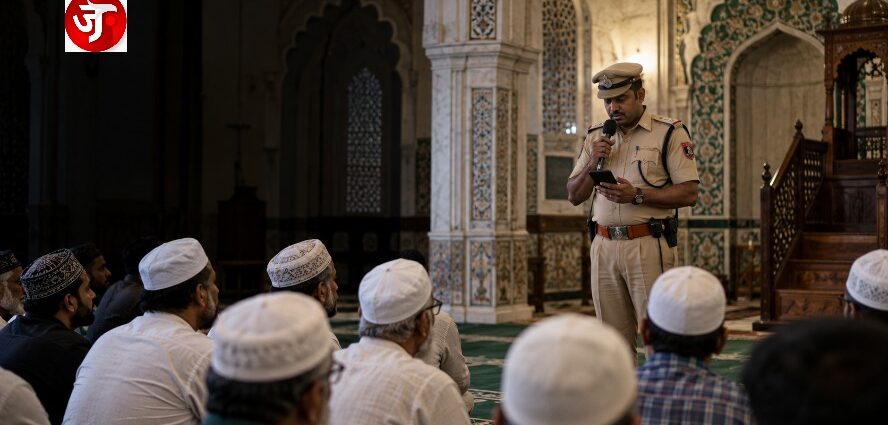
A police personnel addressing citizens inside a mosque in Old Delhi and urging them not to participate in protests has raised uncomfortable questions ahead of the October 10 demonstration at Jantar Mantar. “Advise your friends, family and children not to be part of a crowd unnecessarily, or participate in any protest,” the officer reportedly told the congregation.
October 9, 2026: Delhi Police’s pre-protest outreach appears to extend beyond a single mosque, with reports of visits to religious institutions and community groups. The immediate question is why this message was delivered inside a mosque, specifically to Muslim citizens, and what prompted the police to make this appeal.
Is it merely a routine attempt to maintain law and order? Or are the authorities anticipating a situation that could become far more dangerous than an ordinary political demonstration?
The questions become more urgent against the backdrop of reports of threatening videos circulating on social media ahead of Saturday’s protest. According to media reports, some individuals have allegedly called for people to gather at Jantar Mantar carrying sticks and threatening to confront demonstrators. Delhi Police has said it is monitoring online content and individuals suspected of inciting violence. These reports make the prospect of confrontation a matter that deserves serious attention.
Are the police worried that Muslims could become targets?
One cannot help asking whether the appeal inside the mosque reflects a specific concern that Muslim citizens attending the demonstration could face intimidation or violence if tensions escalate.
Could the police possess intelligence suggesting a risk to particular communities? Are they trying to prevent a potentially dangerous encounter before it happens? Or is this simply part of a wider effort to discourage people from attending an unauthorised gathering?
At present, there is no verified evidence establishing that the officer possessed inside information about a planned attack on Muslim protesters. The warning alone cannot prove that such an attack is anticipated. Nevertheless, when threats of confrontation are being reported, the authorities owe citizens clarity about the nature of the risks and the measures being taken to protect them.
If the police genuinely fear that citizens may be targeted, the obvious response should be to identify and act against those threatening violence, rather than placing the primary burden of prevention on potential victims.
Are the police protecting citizens, or keeping them away from dissent?
Another uncomfortable question concerns the role of the police in a democracy. Delhi Police has been preparing extensively for the October 10 demonstration, with reports describing surveillance of incoming protesters, checks at accommodation facilities, restrictions on gatherings and efforts to discourage students from participating.
The mosque appeal must be examined within this wider context. It may be part of a broader preventive strategy, rather than an initiative directed exclusively at Muslims. But that makes transparency and equal treatment all the more important.
Were similar appeals made to other religious communities? Are those allegedly issuing threats receiving the same attention as those being advised not to protest? And are the authorities equally determined to prevent violence from every side?
These are legitimate questions, not conclusions that can be drawn from one video.
Are the police themselves caught in a bigger game?
There is a deeper concern here. In situations involving mass mobilisation, political confrontation and communal tension, the police are expected to protect citizens impartially. Yet the public has repeatedly witnessed allegations of delayed intervention, uneven enforcement and failures to protect vulnerable people during episodes of violence.
Does the mosque appeal reflect genuine concern among police officers about the possibility of unrest? Could officers on the ground be trying to prevent a situation they fear might spiral beyond their control? And, in the event of a confrontation, would they have the authority, resources and political backing needed to protect everyone equally?
These questions raise the possibility of a police force caught between its constitutional responsibilities, operational orders and the pressures surrounding a politically sensitive event.
But there is an important distinction: a warning does not prove that the police are acting under orders from a hidden power, nor does it establish that they are helpless pawns in a larger political strategy. Such claims would require evidence. The concern is whether the authorities can demonstrate, through their actions, that the law will be enforced impartially.
Are the authorities anticipating something more sinister?
The combination of a major planned protest, reported threats against demonstrators and heightened security has created an atmosphere in which citizens are entitled to demand answers. The police may simply be trying to prevent disorder. Equally, if officials possess credible intelligence about a threat of violence, the public deserves reassurance that preventive action is being taken against those responsible.
What cannot be allowed is a situation in which peaceful protesters are discouraged from exercising their democratic rights while people threatening confrontation are permitted to intimidate them.
The most disturbing possibility is that the police themselves anticipate a confrontation they may struggle to control. That possibility is not proof of a hidden plan, inside information or political interference. But when threats of violence circulate before a major protest, citizens are entitled to ask whether the authorities are prepared to prevent an attack, rather than merely manage its aftermath.
The question is no longer merely why police entered a mosque to advise Muslims against protesting. It is whether the authorities are responding to a credible threat of violence, and, if so, why the public has not been given a clear account of how those threatening violence are being dealt with.
If the outreach is a citywide preventive measure, Delhi Police should say so clearly and demonstrate that it is being applied impartially. If officers possess intelligence suggesting that particular communities or protesters could be targeted, the priority must be to protect those at risk and act against those making threats, not simply discourage potential victims from attending.
A police force must not become a messenger telling vulnerable citizens to retreat while those threatening them remain free to intimidate.
JANPATH NEWS NETWORK (JNN)
Independent. Fearless. On the People’s Path.