









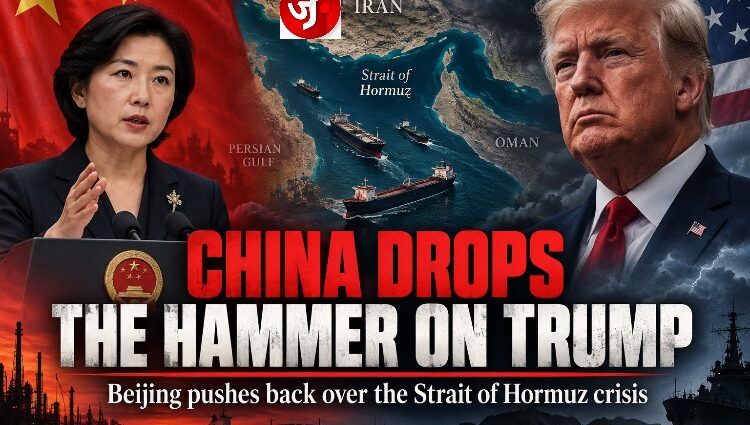
In a moment that sliced through the noise of a world already on edge, Beijing did not whisper. It struck President Trump had laid down his price: two billion dollars a day.
September 18: China has pushed back sharply against Washington’s handling of the crisis surrounding the Strait of Hormuz, arguing that the disruption to one of the world’s most important energy routes stems from the military conflict involving Iran.
On July 13, 2026, Trump said the U.S. intended to control/guard the Strait of Hormuz and that other countries should reimburse the U.S. for doing so. On July 16, the viral post containing the alleged Chinese response began circulating widely. The wording about the Strait being open before the war and the U.S. creating the crisis is consistent with Beijing’s broader stated position, but the exact exchange has not been authenticated. China has officially blamed U.S.-Israeli military operations for the disruption and called for the Strait to be reopened, so the underlying dispute is real even though the dramatic quote may not be.
The confrontation comes as the strategic waterway remains severely disrupted. Reuters reported on September 18 that only four commodity vessels passed through the Strait the previous day, compared with a 10-day average of 16, while shipping companies continue to face significant security risks. The Strait previously carried roughly a fifth of global oil and gas traffic.
The central dispute is over who bears responsibility for the crisis and how the waterway should be reopened. China has repeatedly argued that the disruption is rooted in U.S.-Israeli military operations against Iran. In an April 2 Foreign Ministry briefing, spokesperson Mao Ning said the “root cause” of the disruption was the U.S.-Israeli military operations and called for those operations to end so that shipping could safely resume.
That position has remained broadly consistent. On September 16, Chinese Foreign Minister Wang Yi urged Iran and the United States to exercise restraint, return to their June interim peace agreement and resume substantive consultations. Beijing also called for the reopening of the Strait to protect global energy supplies and shipping.
The dispute has taken on an increasingly striking economic dimension. Trump has previously said Washington would control shipping through the Strait and, in July, announced that the United States would impose a 20% charge on cargo passing through the waterway under a renewed blockade policy.
Against that backdrop, the reported $2-billion-a-day figure has become part of the political argument surrounding the cost of reopening the waterway. However, that specific figure should be attributed to the reported statement rather than presented as an independently established U.S. price for reopening the Strait.
For Beijing, the fundamental argument is different: the Strait was an established international shipping route before the current conflict, and the priority should be de-escalation and restoration of safe navigation rather than turning access into another source of confrontation.
The stakes are enormous. The Strait of Hormuz remains one of the world’s most critical energy chokepoints. Continued disruption is already affecting shipping, oil supplies and global markets, while the conflict has also placed pressure on alternative routes through the region. Reuters reported that traffic remains well below normal levels, while oil prices have remained above $100 a barrel amid continuing security concerns.
China, the world’s largest oil importer, has a direct economic interest in restoring stable energy flows. At the same time, Beijing has sought to position itself as a diplomatic actor calling for restraint rather than direct confrontation.
What began as a battle over a narrow strip of water has therefore become a much larger dispute over military action, energy security, international shipping and who gets to define the terms of the crisis.
The Strait of Hormuz is no longer merely a shipping lane, but has become one of the most consequential pressure points in the global confrontation surrounding Iran.
JANPATH NEWS NETWORK (JNN)
Independent. Fearless. On the People’s Path.