









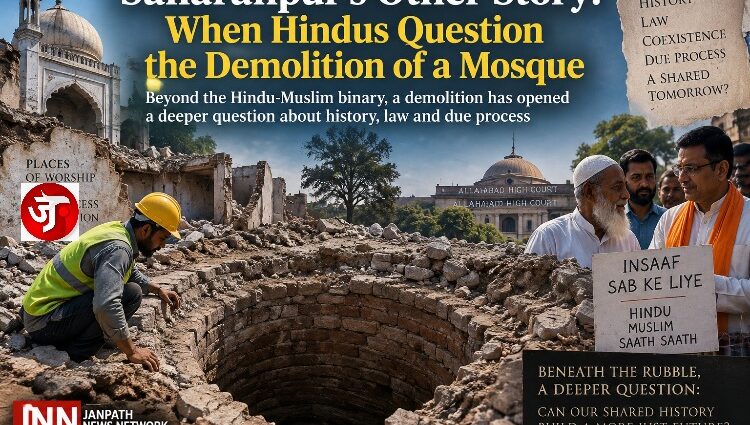
Beyond the Hindu-Muslim binary, a demolition has opened a deeper question about history, law and due process
September 18: What began as a dispute over an allegedly unauthorised mosque at the Saharanpur Collectorate has taken an unexpected turn after archaeologists discovered a nearly 20-foot-deep well beneath the rubble.
The well, uncovered during debris removal on September 6, was examined by archaeology officials who provisionally estimated that its construction could date back 200 to 250 years. The assessment is based on features including Lakhori bricks, lime-surki and the manner in which the structure was built. Officials, however, have stressed that the dating remains preliminary and that further investigation is required to establish its precise history and original purpose.
The discovery has added an unexpected historical dimension to an already charged dispute. But the central question is no longer simply about Hindu versus Muslim, rather about what happens when a place of worship is demolished in the name of removing an alleged encroachment, and whether the legal and administrative process surrounding such an action leaves no room for doubt.
The district administration has maintained that the mosque stood on government land and that the action followed an eviction order. The mosque management, however, has challenged the process, arguing that an order for eviction did not necessarily amount to an express order for demolition. The Allahabad High Court has subsequently sought the Uttar Pradesh government’s response and stayed recovery of a ₹6.41-crore penalty connected with the dispute.
What makes the episode particularly significant is that some Hindu voices have also questioned the demolition. Congress MP Imran Masood said that, in his view, no Hindu would be happy to see another person’s place of worship demolished. His intervention shifts the discussion away from a conventional communal confrontation and towards a broader question of religious coexistence and procedural fairness.
Meanwhile, speculation has emerged over whether the newly discovered well could have any connection with an earlier religious or historical structure. Archaeologists have not established such a connection. Officials have specifically cautioned that the age of the well alone cannot establish whether it was associated with a temple, mosque or any other structure. Evidence, not speculation, will have to answer that question.
Beneath the political noise lies something considerably older than the present dispute: a piece of Saharanpur’s buried history, now exposed only because a structure standing above it was demolished.
The well may eventually tell historians something about the site’s past. The legal proceedings may determine whether the demolition followed the required procedure.
But Saharanpur’s rubble has produced a story larger than the demolition itself: a dispute over land has become a debate about faith, history, constitutional fairness and whether communities can stand up for one another without turning every disagreement into a communal contest.
JANPATH NEWS NETWORK (JNN)
Independent. Fearless. On the People’s Path.