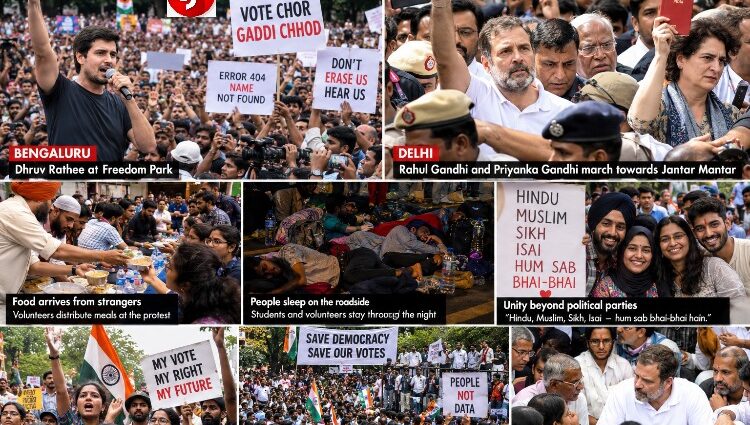
Something unusual is happening on the streets of India. It began as a battle over electoral rolls, the Election Commission and the Special Intensive Revision, or SIR. But from Bengaluru’s Freedom Park to the roads around Delhi’s Jantar Mantar, the protests are beginning to acquire a character that goes beyond political parties and Parliament.
It is becoming a movement of people. In Bengaluru on October 8, Freedom Park became the latest centre of resistance to the SIR exercise. The Cockroach Janta Party and civil-society groups organised a “People’s Tribunal”, where citizens who said they had been affected by the electoral-roll revision came forward to speak about their experiences. YouTuber Dhruv Rathee, actor-activist Prakash Raj and CJP founder Abhijeet Dipke joined the protest.
Rathee’s intervention was deliberately framed around the electoral process rather than a call for a change of government. He said, “I have heard rumours that I have come to India to overthrow the regime. He grinned and said, “Let me assure you, I have not come here for regime change,” he said. He went on to accuse the Election Commission of “zero transparency and zero accountability” over the SIR exercise and joined protesters in raising the slogan: “Vote chor, gaddi chhod.”
But perhaps the most revealing part of Bengaluru was not the presence of a famous YouTuber or a well-known actor. It was the people who stood before the gathering and said, in effect: this is about my vote.
Placards at Freedom Park carried messages such as “Error 404 – Name Not Found” and “Don’t erase us, hear us.” Women, students and citizens from different backgrounds participated in what organisers presented as a public hearing on the alleged problems surrounding the SIR process.
And then there is Delhi. For three consecutive days, Rahul Gandhi and INDIA bloc leaders have attempted to take their protest to the streets over the same larger question of electoral accountability.
The scenes have been extraordinary in their own way. On Wednesday, October 7, Rahul Gandhi, Priyanka Gandhi Vadra and opposition MPs again attempted to reach Jantar Mantar. Police stopped them near Windsor Place. Priyanka Gandhi was seen lying on the road with a copy of the Constitution in her hands. Rahul Gandhi and other MPs were detained.
But the story is not simply about Rahul Gandhi. The march included leaders from across the INDIA bloc. At the lunch before the march were Rahul and Priyanka Gandhi, Congress president Mallikarjun Kharge, K C Venugopal, RJD’s Manoj Jha, IUML’s E T Mohammed Basheer, CPI’s P Sandosh Kumar, CPI(M)’s John Brittas and representatives of other parties.
On October 8, today: The major march led by Rahul Gandhi was the INDIA bloc protest, with Congress and its alliance partners. The reporting on today’s march lists TMC, SP, CPI(M), CPI, RJD and others.
AAP, which had initially kept itself separate from the INDIA bloc’s October 6 march, joined Congress and Left parties in the October 7 protest outside the Delhi Chief Electoral Officer’s office. But today’s Rahul Gandhi-led march remained an INDIA bloc mobilisation, while AAP has thrown its weight behind the larger Jantar Mantar mobilisation planned for October 10.
There was something almost ordinary about the scene before it became extraordinary. The people ate together. The South Indian leaders ordered North Indian dishes. Leaders from northern states ordered South Indian food. Rahul Gandhi shared some of the food he had ordered with others at the table. Then they left the restaurant, boarded buses and headed towards Jantar Mantar.
Outside, the mood changed. Hundreds of Congress workers followed the buses on foot. Police and paramilitary personnel were deployed heavily. Roads were closed. The buses were diverted. Eventually Rahul Gandhi and Priyanka Gandhi were removed by police.
Yet the most striking images from this wider protest movement have often had nothing to do with political leaders. They have been of ordinary people taking care of strangers.
That spirit was already visible during the CJP’s extended Jantar Mantar protest earlier this year, when food began arriving from people who were not even at the protest. Dal chawal, rajma chawal, tea, sandwiches, burgers, bottled water and other supplies were delivered by strangers. Some orders reportedly came from cities hundreds of kilometres away. Volunteers said they often did not know who had paid for the food.
During these three days at Jantar Mantar, at one stage, volunteers near Bangla Sahib Gurudwara were buying food in bulk and carrying it to the protest site when delivery riders were being stopped from entering. People slept on pavements where bedsheets became mattresses, cardboard turned into beds, and bags became pillows.
Young people who had travelled from other states found places on the roadside and stayed through the night. Volunteers arranged water, bedding and food for strangers they had met only hours earlier. Reporting from the protest described students and young people choosing discomfort over silence, sleeping on concrete and returning to the demonstration the next morning.
At the earlier Jantar Mantar mobilisation, one volunteer, Muhammad Junaid, articulated the sentiment in explicitly communal terms. He said: “Hum sab Hindu, Muslim, Sikh, Isai bhai-bhai hain.”
Hindus, Muslims, Sikhs and Christians, he said, were brothers, united around a common demand. He added that at the protest there was “na koi jaat hai na koi dharm”, only a concern for the future of students and the country.
That sentiment was also visible in the slogans reported from the Jantar Mantar movement: “Hindu-Muslim Sikh Isai, aapas mein hai bhai-bhai.” The Wire reported that the protest brought together people across gender, caste, class and religious backgrounds, describing the site as a broad space of dissent and solidarity.
This is important because the politics of the moment can easily reduce everything to Rahul Gandhi versus Narendra Modi, Opposition versus government, Congress versus BJP. The people on the ground are telling a more complicated story. They are saying: this is also about us.
Rahul Gandhi has certainly become one of the most visible political faces of the Delhi mobilisation. On Wednesday, he said: “They can stop a march. They can refuse a meeting. But they cannot stop the will of our people.”
Priyanka Gandhi, after being detained, said: “The nation is run through the Constitution. We will give our lives for this Constitution.”
Those are political statements. But around them is something that politicians do not entirely control: People are making their own choices about whether to come, landing in thousands, they are walking with each other, feeding one another, sleeping beside barricades, travelling from distant states, and stoutly standing alongside people from religions and communities different from their own.
What is unfolding from Bengaluru to Delhi is therefore larger than any single party, leader or protest. It is a moment in which ordinary citizens are refusing to remain spectators: they are travelling across states, standing behind barricades, feeding strangers, sleeping on pavements, raising their voices together and insisting that their vote cannot be treated as a number on a database. Hindu, Muslim, Sikh, Christian and others are standing together, while politicians, activists, students, workers and citizens converge around one fundamental question: does the voice of the Indian people still belong to the people? The answer will not be decided by one speech, one march or one leader. It will be written by the citizens who continue to show up. And when people who have little in common except their citizenship begin standing shoulder to shoulder and refusing to be silenced, a protest can become something far more consequential than a political demonstration: it can become a movement of a nation finding its voice.
JANPATH NEWS NETWORK (JNN)
Independent. Fearless. On the People’s Path.