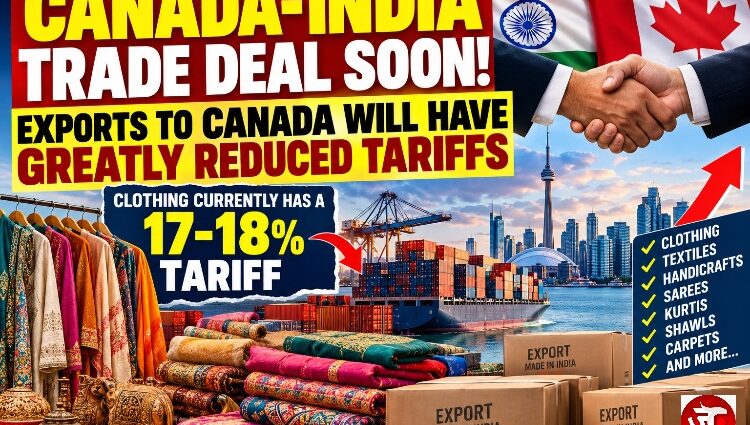
CANADA MAY SLASH TARIFFS ON INDIAN GOODS: CLOTHING EXPORTERS COULD SEE MAJOR BOOST
September 30, 2026: 17–18% duties on several garment categories currently make Indian apparel costlier in Canada. A new trade pact could dramatically change the equation for small traders, textile businesses and handicraft exporters.
India and Canada are moving towards a potentially major trade agreement that could significantly reduce tariffs on Indian exports, opening a much larger window for Indian businesses in the Canadian market.
Negotiations for the proposed Canada-India Comprehensive Economic Partnership Agreement (CEPA) are progressing, with both sides aiming to conclude the talks by the end of 2026. Four rounds of negotiations have now been completed.
For Indian exporters, one of the most important potential gains is tariff reduction. Several categories of clothing currently entering Canada face duties in the 17–18% range under Canada’s existing tariff schedule. That could change substantially if the CEPA delivers preferential access for Indian products.
A potential game-changer for small traders
For a small Indian exporter, an 18% import duty is not a minor detail. It can make a saree, kurti, shawl, stole, kaftan or other Indian garment considerably more expensive for the Canadian customer.
A major tariff reduction could therefore mean: Lower landed cost leading to more competitive prices – more Canadian customers – larger orders with a greater scope for Indian small businesses.
And the opportunity is not limited to factory-made clothing. Indian handlooms, textiles, carpets, embroidery, handicrafts, jewellery and traditional apparel could all potentially benefit from improved market access, depending on the final tariff commitments and rules of origin.
Why Canada matters
India already exports a broad range of products to Canada, including pharmaceuticals, iron and steel, seafood, cotton garments, electronics and chemicals. Canada’s government says two-way merchandise trade reached C$13.6 billion in 2025, while total goods and services trade stood at C$30.4 billion. Ottawa has set an objective of doubling bilateral trade to C$70 billion annually by 2030.
That makes the Canadian market potentially important for India’s growing community of MSME exporters and independent traders.
The catch: the deal isn’t signed yet
The headline is exciting, but the fine print will matter. The CEPA is still under negotiation. The final agreement will determine which products receive tariff concessions, how quickly they take effect and what exporters must do to qualify.
Canada’s customs rules make clear that preferential tariffs depend on the product’s classification and whether it satisfies the agreement’s rules of origin and documentation requirements. So the real business story will emerge when the final tariff schedules are published.
For India’s small exporters, the stakes are enormous
If Canada substantially reduces duties on Indian clothing and other labour-intensive products, thousands of small Indian businesses could gain a more competitive route into one of the world’s major consumer markets.
For a large corporation, an 18% tariff is a cost. For a small trader, it can be the difference between making a sale and losing one.
INDIA-CANADA TRADE DEAL: FROM 18% TARIFFS TO A NEW EXPORT OPPORTUNITY?
The handshake may still be in the making. But for India’s small exporters, the Canadian market is already worth watching very closely.
JANPATH NEWS NETWORK (JNN)
Independent. Fearless. On the People’s Path.