Jaishankar: frustration over stalled UN reform is growing
September 25, 2026: External Affairs Minister S. Jaishankar has called for text-based negotiations to break the long-running deadlock over reform of the United Nations, arguing that meaningful negotiations cannot proceed indefinitely without an actual text on the table.
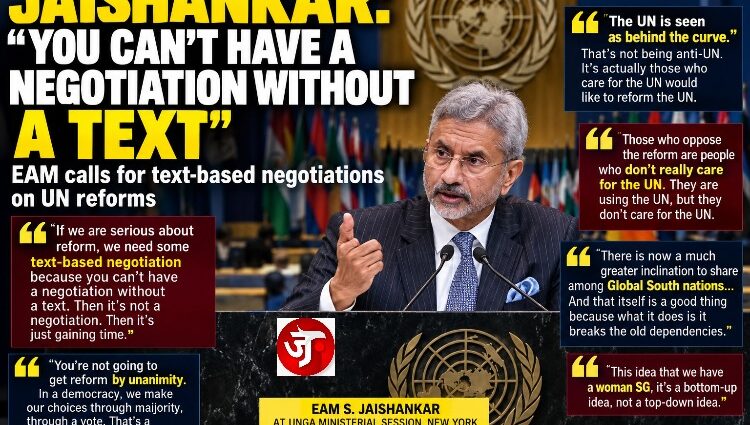
“The frustrations are mounting because at the end of the day, if we are serious about reform, we need some text-based negotiation because you can’t have a negotiation without a text. Then it’s not a negotiation. Then it’s just gaining time,” Jaishankar said.
He said the demand for UN reform, which resurfaces every year during the General Assembly, has acquired greater urgency.
“I feel it’s getting stronger,” he said, adding that the “sentiment for reform” had deepened.
Jaishankar argued that the UN increasingly appears disconnected from contemporary geopolitical realities.
“The UN is seen as behind the curve,” he said, while stressing that demanding reform should not be interpreted as hostility towards the organisation. “That’s not being anti-UN. It’s actually those who care for the UN would like to reform the UN.”
He then made one of his sharpest observations, saying that countries opposing reform were effectively using the organisation without genuinely caring about it.
“I would suggest to you that those who oppose the reform are people who don’t really care for the UN. They are using the UN, but they don’t care for the UN,” he said.
“You’re not going to get reform by unanimity”
Jaishankar also challenged the idea that UN reform must be achieved through unanimity.
“You’re not going to get reform by unanimity,” he said.
Drawing a comparison with democratic decision-making, he argued that countries should first be able to put their positions on the table and then arrive at a decision through voting.
“In a democracy, even at home, we make our choices through majority, through a vote. That’s a democratic way,” he said.
He said the essential first step was to prepare a negotiating text.
“It is a ‘no-brainer’ that if there is a desire for reform, there has to be a text to be negotiated upon,” he said, adding: “You need to get everybody’s ideas on that text, and then you need to find a democratic resolution of those ideas.”
Global South: “breaks the old dependencies”
Jaishankar also linked UN reform to the changing relationships among countries of the Global South.
He said there was now a “much greater inclination to share” among Global South nations, with countries increasingly willing to cooperate and do more with each other.
“And that itself is a good thing because what it does is it breaks the old dependencies,” he said.
He described the resulting shift as contributing to “a more democratic world.”
This fits with comments Jaishankar made earlier during UNGA week, when he said developing countries were bearing the brunt of global crises while remaining under-represented in major decision-making structures.
A woman UN Secretary-General
Jaishankar also touched on the selection of the next UN Secretary-General, saying the idea of having a woman lead the organisation had emerged from countries themselves rather than being imposed from above.
“This idea that we have a woman SG, it’s a bottom-up idea, not a top-down idea,” he said.
India’s longstanding Security Council position
The remarks come against the backdrop of India’s longstanding campaign to reform the UN Security Council, including expansion of both permanent and non-permanent membership. India argues that the current 15-member structure, established in 1945, does not adequately reflect present-day geopolitical realities.
India’s official UNGA81 position specifically says that the previous session’s Intergovernmental Negotiations failed to produce concrete results and that India would push for the early commencement of text-based negotiations, with clearly defined milestones and timeframes.
There is also a broader G4 push. India, Japan, Brazil and Germany recently called for Security Council reform, arguing for expansion in both permanent and non-permanent categories and saying the Council is currently unable to effectively discharge its core responsibility of maintaining international peace and security.
JANPATH NEWS NETWORK (JNN)
Independent. Fearless. On the People’s Path.