









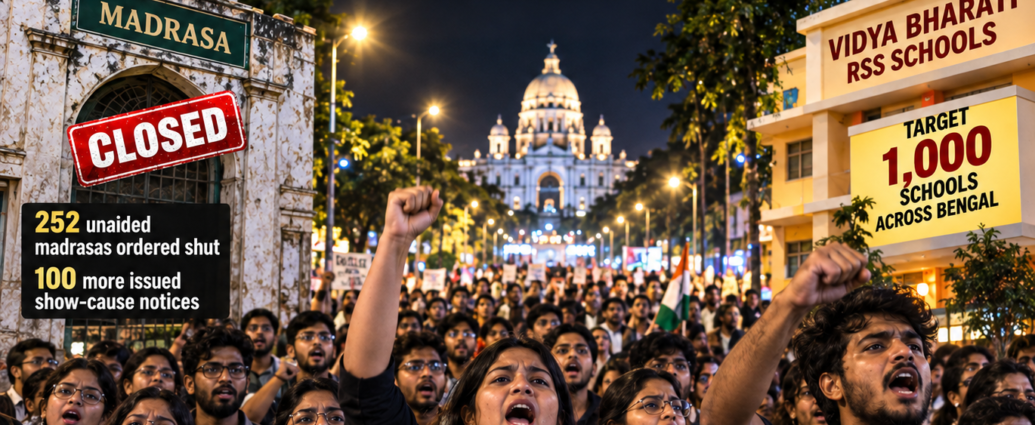
The West Bengal government, now led by Chief Minister Suvendu Adhikari, has ordered the closure of 252 unaided and unrecognised madrasas, commonly called khariji madrasas, after a statewide survey.
September 17: Students and activists took to the streets of Kolkata, challenging the West Bengal government’s decision to shut down hundreds of unrecognised madrasas and questioning what they describe as a widening gap between regulation of minority-run institutions and the state government’s simultaneous encouragement of RSS-linked schools.
The controversy follows a statewide survey that resulted in orders to close 252 unaided and unrecognised madrasas, while around 100 others were issued show-cause notices. The government says the institutions were found to lack requisite approvals, basic infrastructure or adequate management systems. Recognised madrasas that meet the required standards, officials have said, will continue to operate.
The action has triggered sharp political opposition. Indian Secular Front MLA Naushad Siddiqui accused the government of using irregularities at some institutions as a pretext to dismantle a wider madrasa education system. He argued that institutions that genuinely do not exist or fail to meet legal requirements can be investigated, but questioned the broader consequences for students studying in functioning madrasas.
The question protesters are putting to the government
Protesters have focused on a striking coincidence in timing.
On September 4, Chief Minister Suvendu Adhikari announced a target of establishing at least 1,000 Vidya Bharati schools, the education wing of the RSS, across West Bengal within a year. The state currently has 313 Vidya Bharati schools, according to reports. Adhikari said the organisation should take responsibility for what he called “nationalistic learning” and specifically urged expansion in districts including Murshidabad and South 24 Parganas.
Adhikari also proposed merging West Bengal’s four education departments into a single administrative structure, saying there would be no separate administrative arrangement for madrasa education.
That has given protesters a pointed question: if the government is demanding uniform standards across education, will those standards be applied equally to institutions of every community and ideological affiliation?
That question is political, and the answer remains contested.
The state government’s stated position is that institutions operating without the necessary approvals or basic infrastructure cannot simply continue outside regulatory oversight.
Minority Affairs and Madrasa Education Minister Kshudiram Tudu said institutions with the required approvals would continue functioning. Officials said the survey examined infrastructure, approval status and management systems across government and private madrasas.
Panchayati Raj Minister Dilip Ghosh, meanwhile, alleged that there had been cases in which people accused of extremist activity were associated with madrasa teaching. Those claims are part of the government’s political argument for tighter scrutiny, rather than evidence that the 252 institutions ordered closed were themselves involved in extremist activity.
TA regulatory violation, inadequate infrastructure and an allegation of extremist activity are three very different things, despite politics’ persistent talent for throwing them into the same blender.
A broader battle over Bengal’s classrooms
The dispute comes after a series of education-related decisions by the new BJP government that have already generated controversy.
In May, the government made the singing of “Vande Mataram” mandatory during assembly prayers in madrasas covered by the relevant education department, describing the move as an effort to create uniformity in assembly practices. The directive itself generated political opposition.
Now, the closure of 252 unrecognised madrasas and the proposed expansion of Vidya Bharati schools have brought the debate into sharper focus.
Vidya Bharati currently operates 313 schools in Bengal across 150 blocks, according to its officials. The organisation has said it intends to expand to all 345 blocks of the state over the coming years.
For supporters of the government’s policy, the issue is about bringing education under common standards, improving oversight and promoting a common educational framework.
For critics, the simultaneous contraction of one network of minority-run institutions and expansion of an organisation associated with the RSS raises questions about whether “one education system” is being pursued as administrative uniformity or as an ideological transformation of Bengal’s classrooms.
For now, the facts are clear on one point: 252 madrasas have been ordered to close, around 100 more face scrutiny, while the government has publicly backed a dramatic expansion of Vidya Bharati schools. The political argument over whether those developments represent consistent regulation or a double standard is now playing out on Kolkata’s streets.
And beneath all the slogans is the question that actually matters to thousands of students: what happens to their education when institutions become the battlefield for a larger political fight?
JANPATH NEWS NETWORK (JNN)
Independent. Fearless. On the People’s Path.