









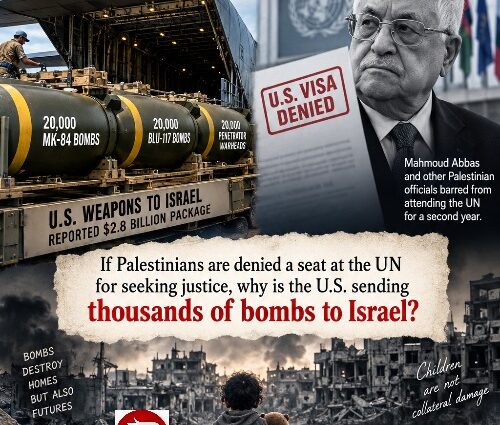
The US has denied Palestinian President Mahmoud Abbas a visa to attend next week’s UN General Assembly in New York, but isn’t the Trump administration preparing a reported $2.8 billion weapons package for Israel that includes 20,000 MK-84 bombs, 20,000 BLU-117 bombs and 20,000 penetrator warheads, according to Reuters reporting based on U.S. officials?
The Trump administration has extended U.S. visa restrictions on senior Palestinian Authority (PA) and Palestine Liberation Organization (PLO) officials, including Palestinian President Mahmoud Abbas, for a second consecutive year, preventing them from travelling to the United States to attend the UN General Assembly.
Washington says the decision is justified because the PA and PLO have, in the U.S. government’s view, “failed to live up to their commitments” and taken actions that undermine the prospects for peace.
The State Department has cited several reasons: Palestinian efforts to pursue cases against Israel before the International Criminal Court (ICC) and International Court of Justice (ICJ); attempts to obtain international recognition of a Palestinian state rather than negotiating directly with Israel; payments to Palestinians convicted of attacks against Israelis and their families; and what Washington describes as the glorification of terrorism in Palestinian official statements and educational material.
The United States therefore presents the visa restrictions as the enforcement of existing conditions imposed on Palestinian officials.
But there is a much larger question buried beneath the diplomatic language:
Where exactly did the Palestinian leadership fail, and why is accountability being demanded from one side while the United States continues to provide Israel with enormous quantities of military weapons during the Gaza war?
That question deserves to be asked without ignoring the documented failures and abuses committed by Palestinian armed groups, including Hamas, or the suffering caused to Israeli civilians. But accountability cannot meaningfully be discussed if it is applied selectively.
The Palestinian case for international accountability
The United States objects to Palestinian efforts to bring Israel before international courts, describing such actions as an attempt to “internationalize” the conflict rather than resolve it through negotiations.
The Palestinian leadership takes a different position. Palestinian officials argue that international legal institutions are precisely where questions of occupation, alleged violations of international law and civilian protection should be examined.
That disagreement is fundamental. If Palestinians believe that negotiations have failed to deliver an end to occupation or establish a viable Palestinian state, seeking recourse through international institutions can be viewed by them as an alternative legal route rather than an abandonment of diplomacy.
The dispute, therefore, is not simply about visas. It is about who gets to define the legitimate route to peace and accountability.
But where is the same scrutiny of Israel?
The question becomes considerably more difficult when Washington’s treatment of Palestinian officials is considered alongside its military relationship with Israel.
The Trump administration is preparing a reported $2.8 billion weapons package for Israel that includes 20,000 MK-84 bombs, 20,000 BLU-117 bombs and 20,000 penetrator warheads, according to Reuters reporting based on U.S. officials.
These are not symbolic diplomatic gestures. The MK-84 and BLU-117 are approximately 2,000-pound-class bombs capable of causing extensive destruction, particularly when used in densely populated areas.
And this is where the debate over accountability becomes impossible to separate from the question of American responsibility. Washington is telling Palestinian leaders that certain actions undermine peace while simultaneously providing Israel with vast quantities of weapons for a war that has produced enormous civilian destruction and loss of life in Gaza.
The United States argues that its military assistance supports Israel’s security and defence. Critics argue that continued weapons transfers risk enabling further civilian harm and undermine Washington’s claims to be an impartial advocate for peace.
There is a striking contradiction in the current American position. Palestinian officials are being restricted from entering the United States because Washington says their actions obstruct peace. At the same time, Washington continues to arm Israel with weapons that can inflict enormous destruction and destroy peace!
Are the attacks on Gaza kept alive just to finance American weaponry? Who is more accountable in this case?
JANPATH NEWS NETWORK (JNN)
Independent. Fearless. On the People’s Path.