









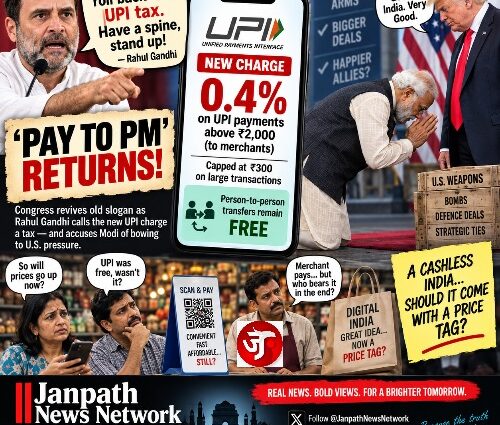
A decade after Rahul Gandhi’s “Pay to PM” jibe during the demonetisation debate, Congress has revived the slogan in a fresh political attack over charges on high-value UPI merchant payments.
A Congress video circulating on X stitches an old clip of Gandhi with the latest controversy over UPI, accusing the Narendra Modi government of turning a payment system once promoted as free into another source of cost for Indians.
The political messaging is blunt. The policy itself, however, is more specific.
From October 15, 2026, a 0.4% Merchant Discount Rate (MDR) will apply to specified person-to-merchant UPI transactions above ₹2,000, with the charge capped at ₹300 for transactions of ₹75,000 and above. Person-to-person UPI transfers will remain free. The government has also said that about 96% of P2M transactions will remain unaffected, while small merchants meeting the specified criteria will continue to receive zero-MDR treatment.
The government insists that MDR is not a tax and that the charge is paid within the merchant payments ecosystem rather than directly by consumers. It has also instructed banks and payment providers that the MDR should not be passed on to customers.
Congress, however, argues that the distinction between “merchant charge” and “consumer cost” may not be so simple.
Rahul Gandhi brings back ‘Pay to PM’
Gandhi has described the new charge as a “UPI tax” and demanded that it be withdrawn.
In a video message, he invoked former Prime Minister Indira Gandhi before turning his attack on Prime Minister Narendra Modi. Gandhi accused Modi of “prostrating himself” before U.S. President Donald Trump and alleged that the UPI policy reflects American pressure.
Gandhi has also argued that transactions above ₹2,000 represent only around 5% of UPI transactions by volume but nearly 65% of their total value. Those figures are part of his argument that the apparently narrow change could nevertheless affect a substantial portion of the money moving through the system.
Congress has further questioned whether the new framework could eventually increase the cost of digital payments for ordinary consumers if merchants attempt to recover their processing costs through prices.
That remains a point of political and economic dispute, because the government explicitly says merchants will not be permitted to pass the MDR directly to customers.
The American connection
Gandhi has gone beyond the question of UPI pricing, alleging that the policy could help open India’s digital-payment ecosystem to American payment companies.
He has linked the issue to wider India-U.S. trade negotiations and accused the government of yielding to American pressure.
The government rejects the description of the measure as a tax. According to the Finance Ministry, the MDR will be distributed among banks, payment-service providers and other participants in the payment ecosystem rather than collected by the government as tax revenue.
From ‘Pay to PM’ to ‘UPI tax’
And so the old political slogan has found a new home. In the aftermath of demonetisation, Gandhi famously used “Pay to PM” as a play on Paytm. Nearly a decade later, Congress is bringing the phrase back to attack a policy that changes the economics of India’s hugely successful digital-payment system.
The irony is hard to miss. UPI was built and promoted as a low-cost digital public infrastructure that helped transform how Indians pay for everything from vegetables to school fees. Now, for specified higher-value merchant transactions, the system is moving into a paid MDR model.
The government calls it a measure for sustainability; Congress calls it a tax; merchants are wondering who will ultimately absorb the cost; and consumers, as usual, are standing in the middle wondering whether “free” has once again acquired a footnote.
The real question is therefore not simply whether 0.4% is a tax. It is who ultimately bears the cost of India’s next phase of digital payments, and whether the change strengthens the UPI ecosystem without quietly shifting the burden down to businesses and consumers. Because in Indian politics, apparently even scanning a QR code now comes with a sequel.
JANPATH NEWS NETWORK (JNN)
Independent. Fearless. On the People’s Path.