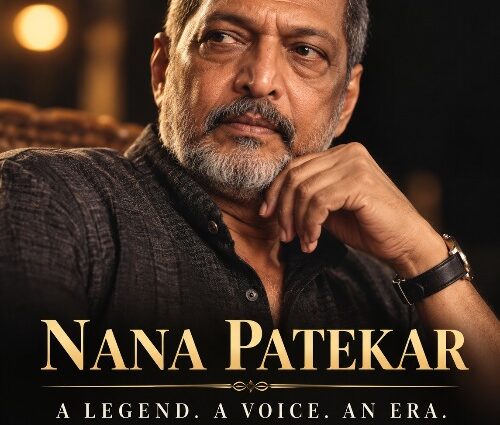
Indian cinema has lost one of its most extraordinary and unmistakable voices. Nana Patekar, who died on October 8, 2026, at the age of 75, leaves behind not merely a filmography, but an enduring legacy of performances that could shake, disturb, move and sometimes even make an audience laugh within the same breath, and with a tender heart, stood with farmers.
Nana Patekar died suddenly of cardiac arrest at his home in Goa in the early hours of October 8, 2026, aged 75.
According to doctors, he had messaged a friend around 2:30 a.m. saying he was feeling unwell. When the friend reached his home around 4 a.m., Nana was reportedly sweating, gasping and unresponsive. CPR was begun at the residence and continued during his transfer to Manipal Hospital. Doctors attempted resuscitation for approximately 45 minutes, but he could not be revived. He was declared dead at about 5:20 a.m.
Importantly, doctors have said that while cardiac arrest is the immediate cause of death, the underlying trigger has not yet been established. A post-mortem has been ordered as part of the medical-legal procedure.
It makes his passing particularly heartbreaking because, by all accounts, it was sudden. One of Indian cinema’s most powerful voices was gone within a few hours.
For nearly five decades, Nana belonged to no formula. From Gaman and Salaam Bombay! to Parinda, Krantiveer, Natsamrat, Ab Tak Chhappan and Welcome, he inhabited his characters with an intensity that was uniquely his own. His voice, his pauses, his eyes and that almost volcanic ability to deliver a line made even silence feel like dialogue. He won three National Film Awards and was honoured with the Padma Shri, but awards could never quite measure what he brought to the screen.
Nana was also a man who carried his own convictions beyond cinema. Through the NAAM Foundation, he worked to support farmers and rural communities, giving his fame a purpose beyond the spotlight.
Away from the cameras and the applause, he chose to stand with people whose struggles rarely received the same attention. Through the NAAM Foundation, he devoted himself to helping distressed farmers and rural communities, offering financial assistance and support to families facing hardship.
In 2015, Nana Patekar had saved around ₹1.5 crore to buy a new car. One evening, while watching television, he saw a report about a farmer who had died by suicide and the devastated family he had left behind. The story shook him so deeply that he called his friend and fellow actor Makarand Anaspure and suggested giving ₹15,000 to each affected family.
But Anaspure told him something important: don’t simply send money. Come to Beed and meet these families yourself.
Nana went.
He found himself sitting among more than a hundred widows of farmers, many holding their children. He later recalled that he had arrived thinking about how much money he could distribute, but left thinking about something much larger: a one-time payment could not solve what these families were facing.
That encounter changed his life.
What makes his story particularly extraordinary is that he did not stop at handing out cheques. In 2015, he and Anaspure founded NAAM Foundation, initially helping families who had lost farmers to suicide. NAAM subsequently moved into the deeper causes of rural distress, including water conservation, irrigation, groundwater recharge, farm ponds, canals and village development.
At one point, Nana was even working toward collective farming, arguing that farmers needed better knowledge of what to grow and access to markets, rather than simply emergency charity.
There is another deeply moving detail. During his visits, Nana encountered families where children had been left dependent on elderly relatives after their fathers’ deaths. In one case, he described a farmer’s widow becoming so exhausted and malnourished while speaking to them that she collapsed in front of him.
The man who gave Indian cinema unforgettable characters also chose to give something back to the people who had little voice. That may ultimately be one of Nana Patekar’s most meaningful legacies: he did not merely speak for the vulnerable. He stood beside them.
Some actors perform. Some actors entertain. Nana Patekar inhabited the human condition. He could be fierce, vulnerable, frightening, funny and painfully real, often without seeming to try. His passing is not simply the end of a remarkable career. It is the closing of an era.
The screen will remain. The films will remain. The unforgettable characters will remain. But that voice, that fire, that unmistakable presence belongs to Nana alone.
Rest in peace, Nana Patekar. You were truly one of a kind.
JANPATH NEWS NETWORK (JNN)
Independent. Fearless. On the People’s Path.