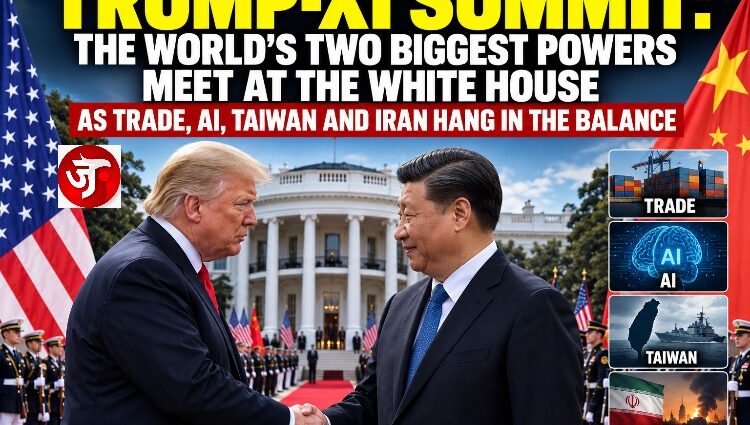
Xi Jinping at the White House for first Washington visit in more than a decade as Trump seeks stability, economic gains and Chinese influence over Iran
SEPTEMBER 24, 2026: The presidents of the United States and China, Donald Trump and Xi Jinping, are meeting at the White House today in one of the most consequential diplomatic encounters of the year, bringing together the leaders of the world’s two largest economies at a moment when their countries are attempting to stabilise relations while remaining deeply divided over trade, technology, Taiwan and the war in Iran. Xi is in Washington for a three-day state visit, his first trip to the US capital in more than a decade.
President Trump personally welcomed him at Joint Base Andrews on Wednesday, in an unusually elaborate reception featuring a long red carpet, military honours and an aircraft flyover, underscoring the significance Washington attaches to the visit.
The symbolism surrounding Xi’s arrival is striking because it comes against the backdrop of one of the most complicated relationships in international politics. Washington and Beijing remain strategic competitors across trade, advanced technology and military influence, yet both governments have also been trying to prevent their rivalry from escalating into a confrontation that could damage the global economy and international security. Reuters described Thursday’s summit as heavy on symbolism and potentially lighter on substantive breakthroughs, with both leaders seeking to demonstrate that the relationship can remain stable despite their fundamental disagreements.
Trade is expected to be one of the most immediate issues on the table. The United States and China agreed this week to extend their existing trade truce by two months, moving its expiration from November to January 10. The extension provides negotiators with additional time to work through disputes and avoids an immediate return to the tariff escalation that has repeatedly shaken relations between Washington and Beijing. But the extension is not a comprehensive trade settlement, and major differences over tariffs, market access, technology and other economic issues remain.
For Trump, the summit also carries a significant economic dimension. Washington is seeking concrete gains from Beijing, while China has an interest in preventing another round of tariff escalation and maintaining access to international markets. The two countries remain deeply economically interconnected even as both governments pursue policies designed to reduce strategic dependence on the other. Reuters has reported that the trade truce, rather than a sweeping new agreement, is likely to remain one of the most important practical outcomes surrounding the meeting.
Artificial intelligence has emerged as another major subject of the summit, adding a technological dimension to the US-China rivalry. Trump said AI would be a “big topic of discussion” with Xi, while also indicating that he wanted the existing situation to remain largely unchanged. The two countries are competing for leadership in advanced AI, semiconductors and other strategic technologies, while simultaneously confronting questions about AI safety and the risks associated with increasingly powerful systems.
That creates an unusual diplomatic problem. Washington and Beijing have an interest in preventing accidents, misunderstandings and uncontrolled competition in artificial intelligence, but they are simultaneously competing for technological leadership. Any agreement on communication or safety mechanisms would therefore have to coexist with restrictions, commercial competition and national-security concerns surrounding advanced technology. Analysts have discussed the possibility of greater direct communication between the two countries on AI-related risks as the technology becomes increasingly important to both economies and militaries.
Taiwan remains another major fault line. China regards Taiwan as part of its territory, while Taiwan has its own elected government and armed forces. The United States maintains unofficial relations with Taipei and has historically provided Taiwan with military equipment, making American arms sales one of Beijing’s most sensitive objections to Washington’s policy. Ahead of the summit, a Chinese defence ministry spokesperson urged the United States to exercise “extreme caution” over arms sales to Taiwan and said the two countries should maintain stable military relations.
For Xi, Taiwan is closely tied to China’s sovereignty claims and national-security policy. For Washington, the issue is connected to its broader strategic position in the Indo-Pacific and its relationships with regional partners. Reuters has reported that Taiwan could become an important bargaining issue during the Trump-Xi discussions, although the precise scope of any possible understanding remains uncertain.
Then there is Iran, an issue that brings the US-China rivalry directly into the Middle East. Trump wants China to use its influence with Tehran, while Beijing has its own economic and strategic relationship with Iran. The war has also affected energy markets and international trade, giving China a direct economic interest in developments surrounding the conflict. The question for Washington is how far Beijing is prepared to cooperate with US efforts concerning Tehran, while China has its own reasons for maintaining diplomatic and economic ties with Iran.
The summit therefore reaches well beyond the traditional US-China agenda. A conversation that begins with tariffs and trade can quickly move into artificial intelligence, Taiwan, military relations, energy markets and the Middle East. That is precisely why the meeting is being watched so closely by governments and markets around the world.
The ceremony surrounding Xi’s visit has been equally significant. The White House planned a formal state arrival ceremony on the South Lawn, followed by talks and a state dinner. The official programme includes military honours and a flyover, while the White House has also invited prominent business and technology figures to the dinner. Xi’s visit is being treated as a full state occasion, rather than simply another diplomatic meeting.
Yet the grandeur of the reception should not be mistaken for the disappearance of the rivalry. The United States and China remain competitors over technology, military influence, trade and global strategic power. Both governments have reasons to avoid an uncontrolled deterioration in relations, but those reasons do not erase their conflicting interests.
For Trump, the meeting offers an opportunity to seek economic concessions from Beijing and cooperation over international issues such as Iran. For Xi, the summit provides an opportunity to press for greater stability in the bilateral relationship, protect China’s economic interests and challenge US policies that Beijing regards as threatening, particularly regarding Taiwan and advanced technology. Reuters and other international reporting indicate that neither side is entering the meeting expecting a sweeping resolution of the fundamental disputes between the two countries.
The significance of the Trump-Xi meeting consequently lies not only in what the two leaders may sign or announce, but also in whether Washington and Beijing can continue managing their competition without allowing it to spiral into a broader crisis. Their decisions affect global trade, technology supply chains, energy markets, military calculations in Asia and diplomatic efforts surrounding conflicts far beyond their own borders.
For the rest of the world, the image coming out of Washington is therefore a complicated one: the presidents of the United States and China standing together beneath the symbols of friendship while negotiating over some of the deepest strategic disagreements of the modern international system. The red carpet is out, the military ceremony is underway and the state dinner awaits. Behind the pageantry, however, Trump and Xi face the much harder task of determining how two increasingly competitive powers can remain rivals without becoming adversaries.
JANPATH NEWS NETWORK (JNN)
Independent. Fearless. On the People’s Path.