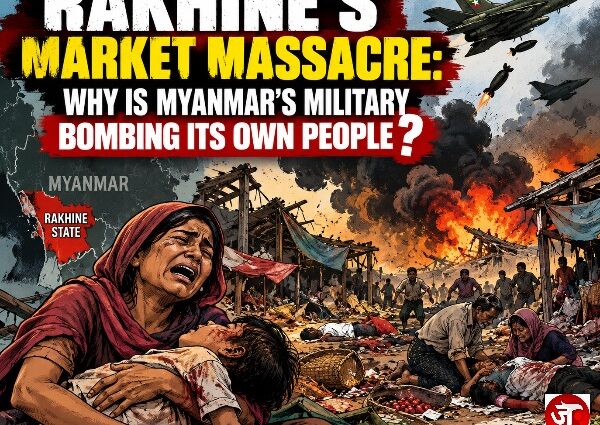
A market in Kyauktaw, Rakhine State, became the latest scene of devastation in Myanmar’s brutal civil war after a military airstrike on September 28. Initial reports put the death toll at 33, but by September 29, local rescue officials and the Arakan Army said the toll had risen to at least 49, with 58 wounded.
The market was reportedly the region’s main wholesale centre, crowded with traders, vendors and shoppers when the strike occurred. The figures have not been independently verified, and Myanmar’s military had not immediately commented.
The obvious question is devastatingly simple: why would a military attack a market filled with its own citizens? The answer lies in the geography and logic of Myanmar’s civil war. Kyauktaw is controlled by the Arakan Army (AA), an ethnic armed organisation fighting for autonomy for Rakhine. Since launching a major offensive in 2023, the AA has captured 14 of Rakhine’s 17 townships, pushing the Myanmar military into a handful of remaining strongholds. Kyauktaw is therefore not simply a civilian town in the government’s eyes but sits inside territory controlled by an armed opponent. Clarity becomes dangerously blurred when the battlefield moves into civilian life.
What does the military want?
The immediate military objective appears to be preventing the Arakan Army from consolidating control over Rakhine. The International Crisis Group says the military has focused on weakening the AA and preventing it from building a viable autonomous region. The army has used blockades, restrictions on trade and communications, artillery and airstrikes as part of that campaign.
There is also a larger strategic prize. Rakhine is home to Sittwe, the state capital, and Kyaukphyu, a strategically important port area containing Chinese-backed energy infrastructure, including oil and gas pipelines and plans for a deep-sea port and special economic zone. The Myanmar military retains positions in Sittwe and parts of Kyaukphyu, making these areas strategically significant far beyond their immediate military value.
Recent fighting around Kyaukphyu has intensified, with the military using airstrikes and naval artillery as it attempts to defend and reinforce its remaining positions.
Why attack civilians?
This is where Myanmar’s long-running “Four Cuts” strategy becomes important. The strategy seeks to sever armed groups from four sources: food, funds, intelligence and recruits among the civilian population. UN documentation has described a pattern in which military operations have treated civilian communities as potential sources of support for ethnic armed groups.
That does not establish that every civilian casualty is deliberately targeted. The military has repeatedly maintained that it attacks legitimate military targets and accuses resistance groups of terrorism. But the UN’s Independent Investigative Mechanism for Myanmar reported in August 2026 that its investigations had found a pattern of deliberate aerial attacks on civilians, including attacks on homes, schools, medical facilities, religious buildings and displacement camps. It also documented increasing use of drones, paramotors and other aircraft.
That makes the Kyauktaw attack particularly disturbing. If a military cannot defeat an armed organisation on the ground, does it attempt to make the territory itself unlivable? That is the larger question hanging over Rakhine.
Rakhine is becoming a battlefield of attrition
Nearly half a million people are displaced in Rakhine, while restrictions on trade routes have contributed to severe food shortages. The latest market bombing therefore comes in a region where civilians are already struggling to obtain food, medicine and basic necessities.
And this is not an isolated incident. A military airstrike on a hospital in Mrauk-U in December 2025 reportedly killed at least 34 people. In August 2026, the UN mechanism warned that aerial attacks by Myanmar’s military had continued to escalate.
The tragedy of Rakhine is that the people caught between the military and the Arakan Army are not abstract populations. They are the market vendors, farmers, children, patients and families who remain after the armies move on.
Myanmar’s military may describe its campaign as a fight against armed rebellion. The Arakan Army describes its struggle as a fight for Rakhine autonomy. But for civilians, this definition can become brutally irrelevant when the sky opens over a marketplace.
JANPATH NEWS NETWORK (JNN)
Independent. Fearless. On the People’s Path.