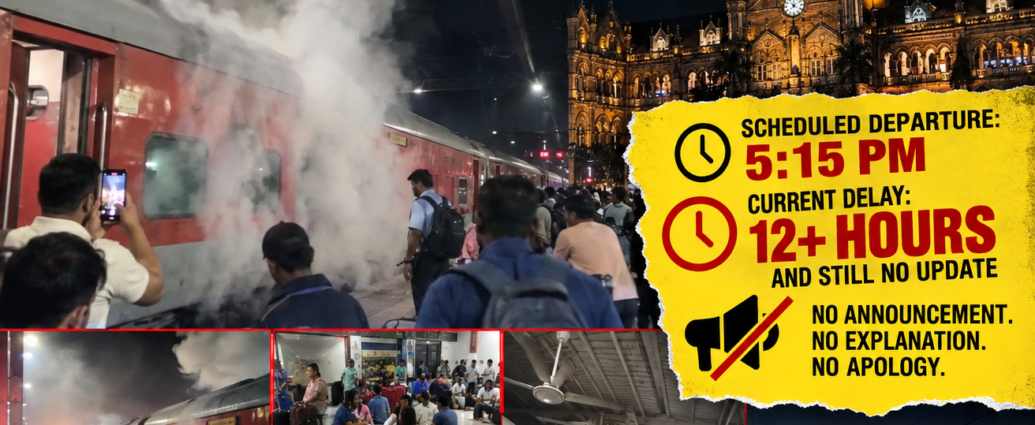
The Mumbai-Howrah Duronto, scheduled to leave CST at 5:15 PM on September 29, reportedly began emitting thick smoke as it moved from the platform, leaving passengers stranded for more than 12 hours, with no official announcements or updates provided to passengers.
A routine train journey turned into a night of uncertainty for passengers of the Mumbai–Howrah Duronto Express after the train reportedly began emitting thick white smoke almost immediately after moving from Chhatrapati Shivaji Maharaj Terminus (CSMT). The train, scheduled to depart at 5:15 PM, was still facing a delay of more than 12 hours by 4:10 AM, according to passenger accounts.
Videos from the station show dense smoke billowing around the red coaches as passengers and onlookers gathered, filmed the incident and waited for information. What appears to have made the situation more distressing was not merely the delay, but the reported absence of clear communication: passengers said they received no adequate announcement explaining what had happened, when the train would move, or what arrangements were being made.
The incident raises an uncomfortable question about passenger safety and accountability. A technical problem can happen on any railway network. What passengers reasonably expect in such a situation is information, assistance and transparency. Instead, according to accounts from the station, some passengers were left waiting into the early morning, with reports of people spending more than 14 hours at CSMT and complaining about inadequate station facilities, including non-functional platform fans.
The train itself is no stranger to disruption. Train records show repeated instances of significant rescheduling of the CSMT–Howrah Duronto in 2026, including departures shifted from its scheduled 5:15 PM timing to late-night or even after-midnight departures. In February 2026, smoke was also reported from a coach of the Howrah–Mumbai Duronto near Chakradharpur, with railway personnel subsequently attending to a brake-binding problem.
That history makes the latest episode particularly worth examining. Is this simply another isolated technical failure, or does it point to deeper problems in maintenance, communication and passenger management?
CSMT is one of India’s most iconic railway stations and a UNESCO World Heritage Site. Its magnificent architecture represents the history and ambition of India’s railways. But for passengers stranded through the night, heritage status means little if basic communication and facilities fail when they are needed most.
A train can be delayed. Machinery can malfunction. What should not malfunction is the system’s responsibility to tell passengers what is happening.
JANPATH NEWS NETWORK (JNN)
Independent. Fearless. On the People’s Path.