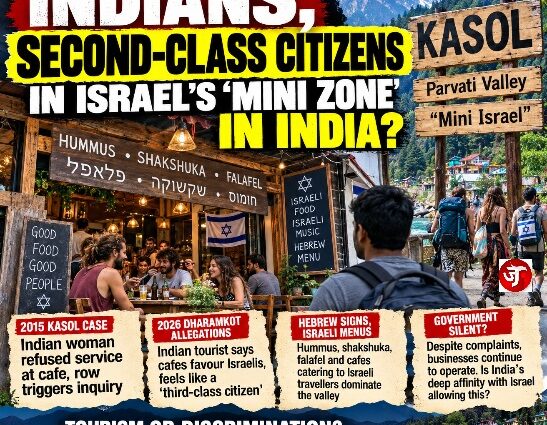
This treatment is a real, localized pattern in a few Himachal backpacker villages, with Israeli-only spaces making Indians feel like second-class citizens in their own country.
Kasol (Parvati Valley) and nearby Dharamkot are nicknamed “Mini Israel” because they sit on the long-standing “Hummus Trail” in Himachal Pradesh, used by tens of thousands of young Israelis after mandatory military service. Hebrew signage, Israeli menus (hummus, shakshuka, falafel), and cafes oriented toward that crowd have existed for years, (since the 1980s.). Some establishments have been accused of preferring or prioritizing Israeli/foreign customers.
The most cited case is Free Kasol / Freekasol Cafe in 2015. An Indian woman was refused a menu while her British partner was served; the manager cited a “members only” policy and the clientele was described as almost entirely white/Israeli. Local reports and an Israeli news channel covered it. The owner/manager was reported as Indian (or Indian with strong Israeli ties), not an Israeli national running a foreign outpost. Himachal authorities ordered an inquiry. Later traveler accounts and some 2025 Hindi reports still mention exclusionary practices or signs at that spot.
In 2026 an Indian tourist publicly described Dharamkot cafes making Indians feel like “third-class citizens”: slower service, priority to Israelis who ordered later, and a general unwelcome atmosphere toward locals. Similar anecdotal complaints circulate about certain Parvati Valley and older Goa spots. These are real hospitality complaints in concentrated tourist enclaves. Some tourists compare it to what they do to the Palestinians.
Most listed Kasol cafes (Evergreen, Moon Dance, etc.) serve mixed Indian and Israeli food to mixed customers. Travel guides note the issue at a handful of places and advise avoiding them. This is closer to the common tourist-enclave dynamic seen in parts of Bali, Thailand, or earlier Goa hippie scenes than to state-backed segregation.
Local officials acted on the 2015 Kasol complaint. Stronger India-Israel ties under successive governments (defense, agriculture, technology) exist and are publicly discussed; they do not equate to tolerating private cafes turning away Indian customers. Private businesses can and do face complaints, social media backlash, and local administrative scrutiny when they discriminate.
Some critics argue that this phenomenon has become more pronounced during the Modi era, amid the BJP and RSS’s increasingly visible affinity with Israel. Whether that political alignment has influenced attitudes within India’s tourism enclaves leaves a point to explore.
The larger question is: “Can any Indian citizen be made to feel like a second-class customer in India because a business has decided that foreigners are more desirable?”
That is a question about equal treatment, tourism economics and the responsibilities of businesses operating in Indian communities. Because a country that welcomes the world should not have to choose between hospitality and dignity. And a bowl of hummus, in all its magnificence, should never require surrendering either.
JANPATH NEWS NETWORK (JNN)
Independent. Fearless. On the People’s Path.