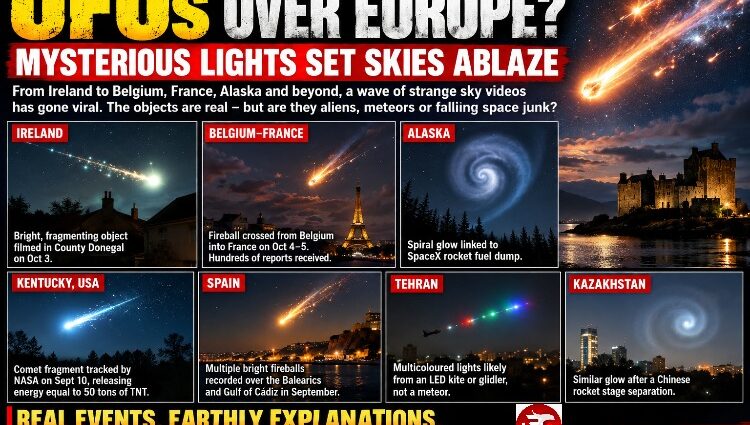
From Ireland to Belgium, France, Alaska and beyond, a wave of spectacular “UFO” videos has sent social media into overdrive.
For several nights, the skies have appeared to put on a show worthy of a science-fiction film. Bright objects have streaked across darkness, fragmented into glowing pieces and, in some cases, remained visible for several seconds. Videos have exploded across social media, accompanied by the inevitable question: Are we witnessing something we do not understand?
The answer, at least from the evidence available so far, is more complicated.
The objects are real. The mystery surrounding them is real. But there is currently no credible public evidence that these events represent extraterrestrial craft or a coordinated unexplained phenomenon.
Ireland’s mysterious fireball
One of the most striking clips emerged from County Donegal, Ireland, on October 3.
Photographer Adam Rory Porter captured the object on a sky camera in Buncrana at approximately 9:35pm local time. Porter initially believed that a firework had exploded above his house.
Instead, his camera recorded a brilliant object travelling across the night sky, apparently breaking apart as it moved.
The footage subsequently circulated widely, with some reports suggesting that it could have been spacecraft debris re-entering Earth’s atmosphere.
Its characteristics, however, are remarkably consistent with a bolide, meteor or high-altitude re-entry: a bright glowing trail, fragmentation and an apparently uncontrolled trajectory.
A separate fireball reported over Northern Ireland around the same period was described as being bright enough to resemble the Moon. The Irish Astronomical Association attributed that event to an asteroid fragment.
And then came another spectacle.-entering Earth’s atmosphere.
Its characteristics, however, are remarkably consistent with a bolide, meteor or high-altitude re-entry: a bright glowing trail, fragmentation and an apparently uncontrolled trajectory.
A separate fireball reported over Northern Ireland around the same period was described as being bright enough to resemble the Moon. The Irish Astronomical Association attributed that event to an asteroid fragment.
And then came another spectacle.
A fireball tears across Belgium and France
During the night of April 2026, hundreds of people witnessed a brilliant fireball crossed the skies from southeast to northwest over Belgium and into France. The April event (around 21:40 on the Sunday evening before the 20 April reports) was covered by VRT NWS with embedded footage under the headline “Spectacular fireball spotted in Flemish skies
The International Meteor Organization received hundreds of reports. Of the first 200 reports analysed, 128 came from France and 54 from Belgium. Witnesses described an object reaching full-Moon brightness, remaining visible for several seconds before disappearing.
Analysts at MIRA Observatory suggested that the object may not have completely disintegrated and that a fragment could potentially have reached the ground in northwestern France.
Suddenly, what looked like an isolated “UFO” sighting began to resemble something else entirely: Earth’s atmosphere was being hit by a series of spectacular visitors from space.
September produced several dramatic fireballs, including an event tracked by NASA cameras and GOES lightning-mapping instruments over western Kentucky on September 10.
A roughly 200-pound cometary fragment entered the atmosphere at an estimated 145,000 mph, disintegrating at an altitude of approximately 48 miles and releasing energy equivalent to around 50 tons of TNT.
Spain also recorded multiple bright fireballs over the Balearic Islands and the Gulf of Cádiz. One was identified as a cometary fragment travelling at approximately 238,000 km/h.
For the night of 4–5 October 2026, Calar Alto Observatory published camera recordings of the bright fireball it detected over the French Pyrenees (more than 700 km away). The page states that two videos from its external north and northeast cameras appear below the text: https://www.caha.es/science-mainmenu-95/meteors-and-fireballs/bright-fireball-registered-in-southern-france-700-km-away-from-calar-alto-observatory. Preliminary analysis there classified it as a Taurid.
The Southern Taurid meteor stream, famous for producing unusually slow and sometimes spectacularly fragmenting fireballs, remains active through November. So the heavens are not exactly short of legitimate reasons to produce strange-looking lights.
But not every “UFO” video is a meteor
Behind the eerie lights and burning trails may lie something far more earthly: meteors, comet fragments and pieces of humanity’s increasingly crowded machinery in space..
Multicoloured lights filmed over Tehran around September 20 showed rapidly cycling red, green and blue illumination. Open-source observers and aviation commentators suggested that the lights could have come from something as mundane as LED lighting attached to a kite or remote-controlled glider.
The apparent low altitude and highly regular lighting pattern are difficult to reconcile with a meteor travelling through the upper atmosphere.
Iranian authorities, meanwhile, did not issue a public threat assessment identifying the object as an unidentified hostile aircraft.
Then there was the extraordinary spiral glowing over Alaska, which looked otherworldly. The spectacular spiral was associated with excess fuel released from a SpaceX Falcon 9 upper stage, with the material illuminated by sunlight high above the atmosphere. A broadly similar phenomenon was observed over Kazakhstan following separation involving a Chinese Long March rocket stage.
Earth now has a lot more junk in the sky
There is another reason these sightings are becoming increasingly common. Space is getting crowded.
Satellites, rocket bodies, fragments and other spacecraft components are continuously entering and leaving orbit. European Space Agency figures indicate that more than three intact satellites or rocket bodies re-enter Earth’s atmosphere on an average day.
Many of these objects burn spectacularly. To someone standing beneath the night sky with no knowledge of what is happening hundreds of kilometres above them, a spacecraft breaking apart in a glowing plasma trail can look profoundly unnatural.
It isn’t.
It is simply human technology coming home the hard way.
The real mystery may be how quickly we call everything a UFO
The American Meteor Society has also recorded an elevated number of widely observed fireballs earlier in 2026, with the January–March figure roughly twice the recent first-quarter average.
Just recently, “A #meteorite fell in #Libya and caused an earthquake that some residents of the capital, Tripoli, felt.”
But there is an important qualification. Some of the increase is almost certainly caused by better cameras, smartphones, automated sky-monitoring systems and a public increasingly willing to report what it sees.
More eyes are watching, a humongous more cameras are recording, and therefore, naturally, more strange things are appearing on our screens.
Yet one fact remains stubbornly important.
No publicly available radar data, multi-station trajectory analysis or recovered material from these recent incidents has demonstrated controlled, non-ballistic movement or exotic materials.
But perhaps that is precisely why the mystery refuses to die. Because when the night sky suddenly ignites above an unsuspecting town, nobody looks up and thinks:
“Probably a piece of orbital hardware.”
They look up and ask the oldest question imaginable:
“What on Earth was that?!!!”
JANPATH NEWS NETWORK (JNN)
Independent. Fearless. On the People’s Path.