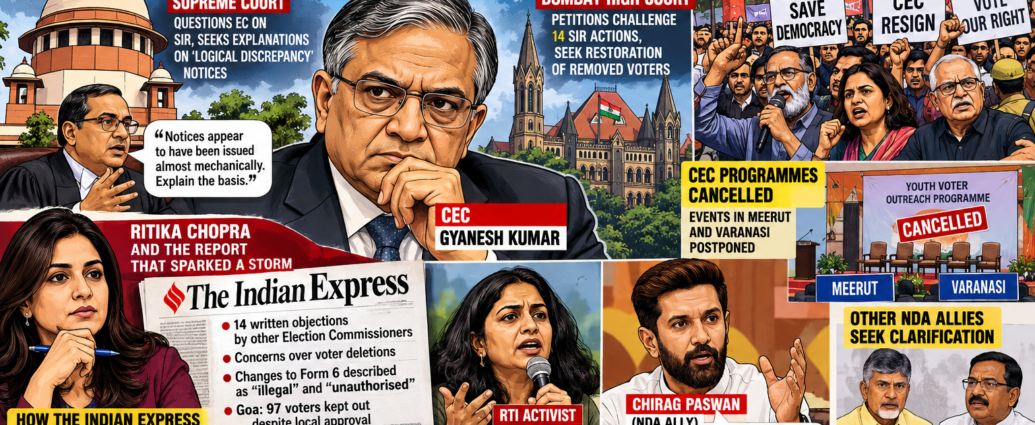
From Jantar Mantar protests and Supreme Court scrutiny to reported dissent inside the Election Commission, postponed public programmes and questions from NDA allies, the controversy surrounding Chief Election Commissioner Gyanesh Kumar is rapidly widening.
September 26, 2026: What began as a dispute over the Special Intensive Revision (SIR) of electoral rolls has developed into a much larger institutional controversy, placing Chief Election Commissioner Gyanesh Kumar and the functioning of the Election Commission of India under intense public, political and judicial scrutiny.
Over the past few days, several developments have converged: an investigation by The Indian Express reporting repeated written objections from the other two Election Commissioners; protests at Delhi’s Jantar Mantar; fresh petitions before the Supreme Court and Bombay High Court; the postponement of two public programmes that Gyanesh Kumar was scheduled to address; and, significantly, calls for clarification from leaders belonging to the BJP-led NDA itself.
Together, these developments have transformed the SIR controversy from a political argument into a broader debate about how India’s constitutional election authority takes decisions and safeguards citizens’ voting rights.
The investigation that changed the debate
At the centre of the latest storm is an investigation by The Indian Express, led by journalist Ritika Chopra.
The newspaper reported that Election Commissioners Sukhbir Singh Sandhu and Vivek Joshi recorded objections on at least 14 occasions over a period of 10 months concerning decisions involving electoral rolls, voter registration, deletion of names and related systems.
One particularly significant report concerned changes to Form 6, used by new voters seeking registration. According to documents reported by the newspaper, the two Election Commissioners objected to a change linked to SIR-related declarations, describing it in their internal communication as “illegal” and “unauthorised” and arguing that it should be removed.
Another investigation examined the case of 97 voters in Goa whose eligibility had reportedly been accepted locally but whose inclusion was prevented by the centrally controlled software system. The Indian Express reported that local officials sent eight emails in seven days seeking intervention, yet all 97 names remained absent from the final electoral roll as of September 20.
The Election Commission has pushed back against the broader interpretation of an institutional rupture. It has said that individual views expressed during deliberations should not be confused with final Commission decisions and maintained that decisions, including those relating to SIR, were ultimately taken unanimously.
That distinction is now one of the central questions in the controversy.
Supreme Court scrutiny adds another dimension
The judiciary has also been examining aspects of the SIR process.
In proceedings concerning Delhi’s electoral-roll revision, the Supreme Court questioned the Election Commission over notices issued for what were termed “logical discrepancies”. Reports of the hearing said the Court expressed concern that some notices appeared to have been issued “almost mechanically” and asked the Commission to explain their basis. The Court also suggested allowing voters to respond through easier electronic methods such as email or WhatsApp.
A separate and important development followed this week: a new petition has now been filed before the Supreme Court specifically challenging alleged unilateral decisions attributed to CEC Gyanesh Kumar in connection with SIR.
The petition seeks, among other reliefs, investigation into alleged large-scale voter deletions and challenges decisions allegedly taken without the concurrence of the other Election Commissioners.
There is an important legal distinction here: these are allegations and requests made in a petition; the Supreme Court has not, merely because the petition was filed, accepted those allegations or ruled against the CEC.
Bombay High Court challenge opens another legal front
The controversy has also reached the Bombay High Court.
Two petitions filed before its Kolhapur Circuit Bench reportedly challenge 14 actions associated with the SIR process and seek restoration of voters allegedly removed without due process. They also seek intervention concerning the conduct of SIR in Maharashtra.
Again, the filing of these petitions is not itself a judicial finding of wrongdoing. But their arrival means that questions arising from the internal Election Commission documents are no longer confined to newspaper investigations or political speeches. They are being placed formally before constitutional courts.
Jantar Mantar becomes the street-level flashpoint
Meanwhile, the dispute has spilled onto the streets.
Protesters gathered at Jantar Mantar in New Delhi on September 25, demanding the resignation and, in some cases, arrest of CEC Gyanesh Kumar over the SIR controversy and alleged irregularities in electoral-roll management.
The demonstration took place amid heavy police deployment and barricading, and several participants were detained. Reports said activists including Yogendra Yadav and Prashant Bhushan were among prominent figures present, while TMC MP Mahua Moitra also joined the agitation.
Separately, opposition-linked protests were reported in several states, indicating that the controversy is expanding beyond Delhi.
The Cockroach Janta Party (CJP), meanwhile, has demanded Gyanesh Kumar’s resignation and threatened a broader agitation if he does not step down. These remain political and activist demands, not findings against the CEC.
CEC’s Meerut and Varanasi programmes postponed
Adding to the political attention, two youth outreach programmes that Gyanesh Kumar was scheduled to address in Uttar Pradesh have been postponed.
The events were planned for Meerut and Varanasi, including interactions connected with Electoral Literacy Clubs and young voters.
Their postponement immediately generated speculation because it came amid the controversy over the reported internal disagreements.
The Election Commission, however, has explicitly denied that connection.
EC sources said the postponement decision had been taken on September 21 and attributed schedule changes to logistical and local factors, including venue availability and official commitments.
Therefore, while the timing has attracted attention, there is presently no established evidence that the programmes were postponed because of the controversy.
Then came an unusual development: questions from NDA allies
Perhaps one of the more politically significant developments is that demands for an explanation are no longer coming exclusively from opposition parties and activists.
Union Minister and Lok Janshakti Party (Ram Vilas) chief Chirag Paswan, an NDA ally, said the Election Commission should publicly clarify the questions that have arisen.
Paswan said that if doubts begin to develop about the electoral process itself, that becomes problematic, and argued that the Commission’s responsibility was to reassure the public rather than merely answer opposition politicians.
Other NDA allies have also sought clarification. The Indian Express reported that representatives of the TDP and RLM were among those saying that the Commission should address the concerns and remove public misgivings.
This does not amount to an NDA verdict against the CEC. It does, however, show that calls for greater transparency have spread beyond the Opposition.
Why The Indian Express reporting has become central
One striking feature of this episode is the role of documentary journalism.
Rather than resting primarily on political accusations, The Indian Express investigation has reported from internal notes, letters, communications and records concerning the functioning of the Election Commission. Ritika Chopra’s reporting has subsequently been cited in political reactions and in litigation challenging aspects of the SIR process.
That does not make every interpretation of those documents automatically correct, nor does it settle the legal questions. But it helps explain why the investigation has travelled so rapidly from a newspaper’s pages into Parliament-level politics, street protests and court petitions.
The story is no longer simply about whether the Opposition trusts the Election Commission.
The larger question now being debated is how decisions affecting India’s electoral rolls were made, what weight was given to objections recorded by Election Commissioners, and whether existing safeguards adequately protect eligible voters from wrongful exclusion.
The Election Commission’s position remains that its final decisions were unanimous and that differences expressed during internal deliberations should not be portrayed as decisions taken against the will of the Commission.
That response will now be tested not only in the political arena but through documents, judicial proceedings and continued public scrutiny.
With Supreme Court litigation now filed, Bombay High Court petitions pending, protests intensifying, NDA allies asking for clarification and the Election Commission defending its decision-making process, the controversy surrounding CEC Gyanesh Kumar has entered a new phase.
The next crucial developments may come not from political speeches, but from the courts, the Election Commission’s own records and whatever further documentary evidence emerges.
For the moment, the CEC-SIR controversy remains one of India’s fastest-moving political and constitutional stories, and every new court hearing, Election Commission response and disclosure could alter the picture again.
Janpath News Network