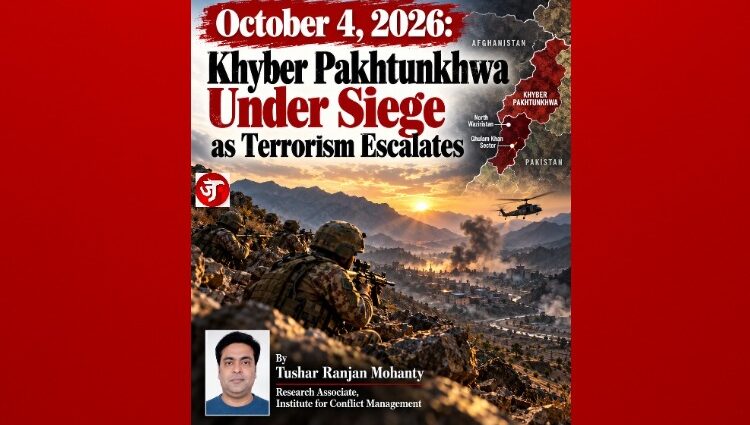
Terrorism is rising despite the continuing operations, nothing has deterred militants from striking back.
By Tushar Ranjan Mohanty
Research Associate, Institute for Conflict Management
Counter-terrorism Expert on Pakistan

October 7, 2026: On October 4, Khyber Pakhtunkhwa woke to another bloody confrontation as Pakistan’s security forces fought to stop a militant infiltration attempt along the volatile Pakistan-Afghanistan border. In the Ghulam Khan sector of North Waziristan, at least 15 terrorists were killed, including Mazdigari Marwat, described as a commander of the Waziri group of the Tehreek-e-Taliban Pakistan (TTP), as security forces moved to neutralise the attempted incursion
Khyber Pakhtunkhwa is facing an increasingly fragile security environment as terrorist attacks intensify, security forces struggle to contain militant networks and political confrontation between Islamabad and the provincial government threatens to further weaken the response.
The scale of the violence is stark.
On October 4, 2026, SFs killed eight TTP terrorists, including three key terrorists ‘commanders’, during an intelligence-based operation (IBO) in Dera Ismail Khan District.
On October 3, 2026, SFs killed five terrorists during an IBO targeting terrorist hideouts in the Bajaur District.
On October 3, 2026, SFs killed five TTP terrorists during an IBO targeting hideouts in South Waziristan District.
On October 2, 2026, SFs killed seven TTP terrorists during an IBO in the Eidak area of North Waziristan District.
On September 29, 2026, SFs killed eight TTP terrorists during an IBO in the Tirah area of Khyber District.
On September 29, 2026, SFs killed five TTP terrorists during an IBO in the Bara tehsil (revenue unit) of Khyber District.
On September 27, 2026, at least 15 TTP terrorists were killed by SFs during an IBO in Kurram District.
But the continuing list of operations have not stopped militants from striking back.
On September 26, at least 12 people were killed and 35 injured when a suicide bomber drove an explosives-laden tractor trolley into the Aman Mela Police Check Post in Dera Ismail Khan. In a chilling follow-up attack, unidentified terrorists opened fire on a Rescue 1122 ambulance carrying bodies from the blast site, killing two rescue workers and injuring another person.
Two days earlier, on September 18, the violence struck the heart of the security establishment in Kohat. At least 22 people, including 15 policemen, were killed and more than 100 injured when an explosives-laden vehicle detonated near a mosque at the Police Lines. Terrorists then stormed the compound and attacked police facilities. Seven terrorists were subsequently killed in the clearance operation.
The numbers tell a grim story: According to partial data compiled by the South Asia Terrorism Portal, Khyber Pakhtunkhwa recorded 1,702 terrorism-related fatalities during the first nine months of 2026. These included 1,132 terrorists, 319 security personnel and 251 civilians.
That is the highest January-to-September figure recorded in the province since 2009. The comparable figure for the first nine months of 2025 was 1,570. In 2024 it was 851. The toll had fallen dramatically in the years before the latest resurgence, reaching 104 in 2019 and 103 in 2018.
The deterioration is even clearer when attacks themselves are examined. A policy review released on October 2 by the Islamabad-based Pak Institute for Peace Studies found that terrorist attacks in KP increased from 111 in 2021 to 413 in 2025, a staggering rise of 272.1 per cent. The province accounted for more than half of all terrorist attacks recorded across Pakistan in every year of that five-year period.
The burden has been particularly severe in the southern districts. In 2025, 248 attacks were recorded in North Waziristan, South Waziristan, Bannu, Tank, Lakki Marwat and Dera Ismail Khan alone, accounting for approximately 60 per cent of all terrorist attacks in the province.
The police are paying the price: For the KP Police, the resurgence has been devastating. According to Central Police Office data cited in the source material, 2025 was the deadliest complete year in the history of the KP Police, with 235 personnel killed in the line of duty.
The number has risen sharply since 2021: 63 policemen were killed that year, 93 in 2022, 197 in 2023 and 169 in 2024. By the end of the first seven months of 2026, another 156 police personnel had already been killed, placing the force on course for another exceptionally deadly year.
And the threat is evolving. Terrorist groups are increasingly using sophisticated quadcopter drones to target police personnel and installations, adding a new dimension to an already complex battlefield. KP Police established the country’s first Unmanned Aerial Vehicle Division in March 2025. Officials said that 341 terrorist drone attacks had been thwarted during the first six months of 2026 using counter-drone technology.
Yet technology alone cannot compensate for weak infrastructure. Police authorities have identified more than 100 vulnerable and dilapidated check posts across southern KP and the former tribal areas. Many suffer from damaged roofs, weak boundary walls and inadequate protection. Several police stations have still not been established in parts of the former FATA despite the merger of thousands of personnel into the provincial police force.
The situation has become so dangerous in some southern districts that police had reportedly almost abandoned patrolling outside police stations after sunset.
The Afghanistan factor: The current wave of violence has deep roots. The source attributes the resurgence principally to two developments: the withdrawal of US and Western forces from Afghanistan and the Taliban takeover of Kabul in August 2021, followed by the collapse of government-TTP talks in November 2022.
Pakistan has also repeatedly raised concerns over weapons left behind following the US withdrawal. In January 2025, the Foreign Office said that advanced weapons left in Afghanistan had subsequently been used by terrorist organisations, including the TTP, in attacks inside Pakistan.
The geography of the province compounds the problem. The southern districts lie along the Pakistan-Afghanistan border and at the intersection of settled areas and the former tribal belt, giving militant groups opportunities for movement and concealment across difficult terrain.
When politics collides with counter-terrorism: Perhaps the most troubling dimension of the crisis is that the security challenge is unfolding alongside a bitter political confrontation.
The federal PML-N-led government and the PTI-led provincial government have traded accusations over who is responsible for the worsening security situation.
On September 28, Federal Information Minister Attaullah Tarar accused the KP government of failing to take adequate ownership of counter-terrorism efforts and alleged that the provincial administration had failed to strengthen the security apparatus despite receiving funds for the fight against terrorism.
A federal white paper released the same day claimed that KP recorded 680 terrorist attacks between January and September 2026, compared with 508 during the corresponding period of 2025, an increase of 33.9 per cent.
It also cited a sharp rise in police casualties, saying 122 police personnel were killed during the first half of 2026 compared with 63 during the same period in 2025. The document highlighted serious shortages within the Counter Terrorism Department, including bulletproof vehicles, rifles, night-vision equipment and personnel.
The KP government has rejected the allegations, arguing that the province itself is a victim of terrorism and that its people have paid an enormous price in lives. Provincial Information Minister Shafi Jan accused the federal government of turning the security crisis into a political confrontation.
A province caught between bullets and blame: The danger is that while governments trade accusations, militants continue to exploit the gaps.
Khyber Pakhtunkhwa is now confronting multiple threats simultaneously: expanding terrorist networks, increasingly sophisticated attacks, vulnerable police infrastructure, shortages within counter-terrorism units, cross-border militant mobility and a widening political divide between the federal and provincial governments.
The numbers are no longer merely statistics. They represent police officers killed on duty, civilians caught in explosions, rescue workers attacked while doing their jobs and communities living under the shadow of violence.
The central question is no longer simply whether security forces can kill more terrorists. It is whether Pakistan’s political and security institutions can overcome their divisions quickly enough to prevent Khyber Pakhtunkhwa from sliding even deeper into instability.
For now, the province remains caught between terrorism on the ground and political blame at the top.
Tushar Ranjan Mohanty
Research Associate, Institute for Conflict Management