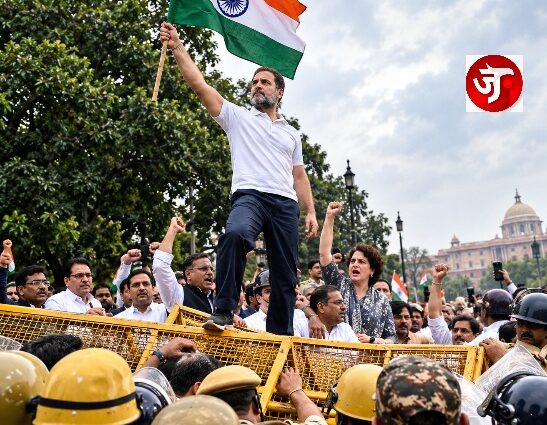
It began as a few seconds of protest footage. Rahul Gandhi standing on a Delhi Police barricade, surrounded by opposition MPs and protesters, the Tricolour in his hand, refusing to be swallowed by the police cordon.
Then came the music.
A reel was set to “I’m Unstoppable”, carrying the line:
https://www.facebook.com/reel/1924850271528458: Reel “Unstoppable” Of Rahul Gandhi Gets 65 Million Views. Protest Captures International News“It was raining in Parliament, but the flame of the people’s questions did not die out.”
The image travelled far beyond the protest site. The reel was reported to have crossed 65 million views, turning a moment of confrontation into something much larger: a symbol of defiance that rose when asking for accountability, that millions of people were watching on their phones. The Indian Express reported that the image quickly went viral, with the reel crossing millions of views within hours.
The 65-million-view is significant because the image has escaped the Parliament–Election Commission confrontation. and entered the phones of ordinary Indians.
And perhaps that is precisely why the image has acquired such force because this was not simply Rahul Gandhi standing on a barricade. It was a politician, already the Leader of the Opposition, visibly confronting a wall of police and refusing to retreat, while asking tough questions.
Rahul Gandhi’s confrontation with the Delhi Police and the Election Commission protest is now receiving substantial international coverage, not merely Indian political coverage. And some of the images are being distributed by major international news agencies, which is significant.
The strongest international outlets covering the October 6, 2026 events are:
Reuters reported Rahul Gandhi and Priyanka Gandhi being detained during the protest and the confrontation over the barricades. Reuters also has a striking photograph of Rahul standing atop the barricade.
Al Jazeera carried the story prominently, describing Rahul Gandhi among opposition legislators briefly detained after protesters attempted to breach barricades. Its report uses AFP/AP/Reuters material as well.
BBC international coverage reported the detention of opposition leaders and Rahul Gandhi’s protest against the Election Commission. The BBC coverage is also referenced in current international aggregations of the story.
Financial Times is listed among the international outlets reporting the October 6 electoral protest and demands for Gyanesh Kumar’s resignation.
Deutsche Welle (DW) covered the opposition’s march towards the Election Commission and the growing controversy around the voter-roll revision.
AFP its photographer’s image of Rahul Gandhi participating in the march has been carried internationally, and AFP directly reported seeing Gandhi standing on the police barricade waving the Indian flag before his detention.
Associated Press (AP) its reporting is being carried through international outlets, including Al Jazeera’s coverage of the detention.
The Guardian has a dedicated Rahul Gandhi topic page and has previously prominently covered his detention and confrontations with Delhi Police.
El País of Spain published an international report on the October 6 opposition march, the detention of Rahul and Priyanka Gandhi, and the broader dispute over the Election Commission.
Free Malaysia Today published the AFP report, including the detail that AFP’s reporter saw Rahul standing on the barricade with the Indian flag.
The Phnom Penh Post also carried the story of Rahul and Priyanka Gandhi being detained after the prolonged Election Commission protest.
Dawn in Pakistan published the Reuters/AFP account of Rahul Gandhi’s detention and the opposition march.
On Tuesday, October 6, INDIA bloc MPs marched from Parliament towards the Election Commission, demanding the resignation of Chief Election Commissioner Gyanesh Kumar and raising allegations concerning the Special Intensive Revision of electoral rolls.
The march was stopped by layers of police barricades. Opposition MPs were detained and pushed into buses. Rahul Gandhi climbed onto a barricade and waved the Tricolour. Priyanka Gandhi Vadra was also detained, but the Gandhi siblings then made an unexpected move, walking into the Akashvani Bhawan premises and turning what could have been a routine detention into a prolonged confrontation.
For hours, Rahul and Priyanka remained there. Eventually, after an approximately nine-hour standoff, Delhi Police moved in to clear the premises. Rahul Gandhi was physically removed and taken towards a police vehicle.
As the INDIA bloc’s march towards the Election Commission was stopped by police barricades, Priyanka Gandhi joined Rahul Gandhi and other opposition MPs in the protest. She was detained and taken towards a police bus, but soon emerged and rejoined the protest near Akashvani Bhawan. Later, when police moved in to clear the sit-in, she was again physically escorted away along with the other opposition leaders.
The footage has spread rapidly across social media and news platforms, showing the visibly tense confrontation between police personnel and the protesting leaders. Priyanka can be seen resisting the attempt to remove her as the police move the protesters towards detention vehicles.
The images of Priyanka Gandhi Vadra being handled by Delhi Police during Tuesday’s protest are among the most disturbing visuals to emerge from the confrontation, being dragged, and her clothes allegedly lifted up. This is not the first time she has been involved in such confrontations with police. In an earlier 2026 protest, she alleged that male police personnel had dragged protesters away and that her clothes had been torn during the operation. She was eventually taken into custody and transported to Kingsway Camp along with Rahul Gandhi and other opposition leaders.
Tuesday did not happen in isolation. The anger surrounding the Delhi Police’s handling of protests had already been building over the preceding days.
On October 3, three women journalists alleged sexual harassment or misconduct by police personnel while covering protests at Jantar Mantar. Delhi Police acknowledged receiving their complaints and said they had been transferred to the Crime Branch for investigation. Journalists subsequently gathered outside the Parliament Street police station demanding action.
Rahul Gandhi publicly questioned why an FIR had not been registered and alleged that journalists had been dragged away and cameras snatched.
The protests did not subside, rather, intensified. And the images coming out of Delhi became increasingly difficult to dismiss as ordinary political theatre. Women protesters and journalists alleged manhandling, and videos circulating reveal that. Opposition leaders were repeatedly detained, while barricades multiplied across central Delhi, and on Tuesday, the confrontation reached the country’s most visible opposition figure.
Something is changing. Perhaps the most important development is not the detention itself, rather, the reaction. People are beginning to look at these images differently, where the argument is no longer confined to Congress versus BJP or Rahul Gandhi versus Gyanesh Kumar, but rather, a stronger question of accountability.
The nation needs to know. The people deserve answers, respect, dignity and accountability.
A government cannot simply do as it pleases, silence those who question it, or treat dissent as defiance. In a democracy, the people have the right to ask questions, demand answers and hold those in power accountable.
Power is not a licence to silence the people. Democracy means the people must be heard.
JANPATH NEWS NETWORK (JNN)
Independent. Fearless. On the People’s Path.